If the starter clicks, the headlights look weak, or the engine cranks slowly, you can test battery car multimeter readings before buying a replacement. A basic digital multimeter costs about $15 to $40 and can tell you whether the battery is discharged, failing under load, or being charged incorrectly. The procedure takes less than ten minutes and works on most 12-volt cars, trucks, and SUVs.
Park on a level surface, switch off the ignition and accessories, and open the hood. Keep rings, watches, loose clothing, and tools away from the belt and fan. Battery terminals can deliver very high current, and lead-acid batteries can produce explosive gas, so do not create sparks near the case. Wear eye protection, especially if the battery is cracked, swollen, or leaking.
Set up the multimeter before testing
To test battery car multimeter settings correctly, plug the black lead into COM and the red lead into the port marked V or VΩ. Do not use the current or amp port for a voltage check. Set the meter to DC voltage, shown as V with a straight line. If the meter is not autoranging, select the 20-volt range. A 12-volt automotive battery normally measures between roughly 12 and 13 volts at rest.
Touch the red probe to the positive terminal and the black probe to the negative terminal. The probes should contact clean metal, not a thick layer of corrosion or an accessory clamp with a poor connection. A positive reading means the leads are connected normally. A negative sign means the probes are reversed; the measurement is still valid, but swap them before recording results.
For an honest resting measurement, let the vehicle sit with the engine off for at least 30 minutes. Surface charge left by driving or charging can make a weak battery look healthier than it is. If you cannot wait, turn on the headlights for two minutes, switch them off, and wait another few minutes before measuring.
Read the resting battery voltage
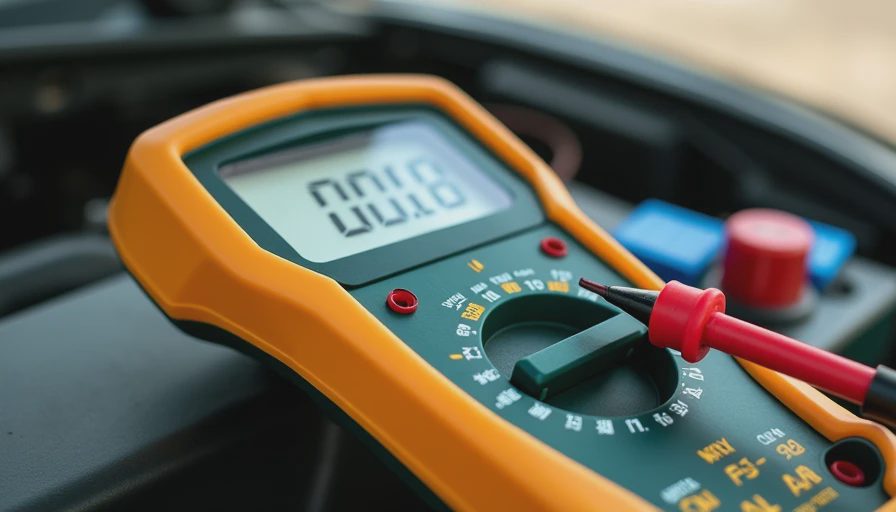
The most useful test battery car multimeter result comes with the engine off. A healthy, fully charged battery often reads about 12.6 to 12.8 volts at room temperature. Around 12.4 volts indicates approximately a three-quarter charge, while 12.2 volts is near half charge. A reading close to 12.0 volts means the battery is heavily discharged, not automatically ruined.
Charge a low battery with a suitable automotive charger and repeat the resting test. If the voltage rises normally but falls back below about 12.4 volts after sitting overnight, the battery is losing charge or has insufficient capacity. A battery that has been deeply discharged can also be damaged even if it temporarily reaches 12.6 volts. Age matters: many starting batteries last roughly three to five years, depending on climate, vibration, and driving habits.
Do not diagnose the entire electrical system from one low reading. A vehicle that sat for several weeks, has an interior light left on, or has a failed alternator can all produce the same initial number. Record the voltage, charging history, and time since the engine last ran.
Perform a cranking voltage test
Resting voltage does not show how the battery performs under starter load. To test battery car multimeter behavior during cranking, keep the probes on the terminals and have another person turn the key or press the start button. Disable fuel or ignition only if you know the correct procedure for that vehicle; otherwise perform a normal start attempt and watch the display.
During a few seconds of cranking, voltage should generally remain above about 9.6 volts at approximately 70 degrees Fahrenheit. Colder temperatures can reduce the number, while a high-compression engine, thick oil, or poor cable connection can increase the demand. If the display drops sharply to 8 or 9 volts and the starter turns slowly, suspect a weak battery, corroded connection, or starter problem.
A battery may show 12.6 volts at rest and still fail this test because its internal plates cannot supply current. Clean the terminals, charge the battery fully, and repeat the test. If the result remains poor, a professional conductance or load test can confirm the diagnosis before replacement.
Check alternator charging voltage
The next test battery car multimeter procedure checks whether the charging system is replenishing the battery. Start the engine and measure directly across the battery posts at idle. Many conventional vehicles show approximately 13.8 to 14.7 volts with the engine running, although smart charging systems can intentionally vary voltage outside that range.
Turn on the headlights, blower motor, rear defroster, and heated seats if equipped. The voltage should remain stable enough to support the vehicle rather than steadily falling toward the resting battery voltage. A reading around 12.2 to 12.7 volts with the engine running can indicate an alternator, belt, wiring, fuse, or control-system issue. A reading consistently above about 15 volts suggests overcharging, which can damage the battery and electronic components.
Measure at the battery posts first, then compare with the alternator output terminal only when you can do so safely. A significant difference points toward resistance in the positive cable or engine ground path. Keep the leads and hands away from rotating pulleys.
Find a parasitic drain after shutdown
If the battery repeatedly goes flat overnight, test battery car multimeter results should include a possible key-off current check. This is a different operation from voltage testing. Set the vehicle up with doors latched, the hood switch managed, and all electronics off. Modern vehicles can need 20 to 45 minutes to enter sleep mode.
Never place an ordinary multimeter in amp mode directly across the battery terminals. That creates a short circuit and can blow the meter fuse. Instead, disconnect the negative cable, connect the meter in series between the cable and negative post, and begin on the highest amperage range. After the modules sleep, a normal draw is often below roughly 50 milliamps, though some vehicles specify more. Move to a lower range only if the measured current is safely within that range.
If the draw is excessive, remove one fuse at a time and watch for a major drop. Record the fuse location before pulling several. Common causes include aftermarket stereos, dash cameras, trunk lamps, remote starters, and glove-box switches that do not close completely.
Avoid common multimeter mistakes
The most common error when you test battery car multimeter readings is measuring a dirty terminal instead of the battery post. Corrosion can hide a bad connection or create a misleading voltage drop. Another mistake is testing immediately after driving, when surface charge inflates the number. A third is blaming the battery when the starter cable or ground strap is loose.
Do not hold both probes in one hand while reaching across the battery, and do not let the probe tips touch each other. Do not use resistance mode on a powered circuit. Replace a blown meter fuse with the correct rating rather than bypassing it. If the battery case is swollen, hot, or leaking, stop testing and arrange safe replacement.
Write down four readings: rested voltage, cranking minimum, running voltage at idle, and running voltage with accessories on. This record separates a discharged battery from a charging fault and gives a repair shop useful evidence.
A practical diagnosis sequence
Start with a visual inspection of the case, terminals, hold-down, belt, and ground cable. Then test battery car multimeter voltage after the vehicle rests. Charge it if necessary and repeat the resting measurement. Next, perform the cranking test, followed by alternator output checks. Only investigate parasitic drain after confirming the battery is charged and the charging system works.
For example, 12.6 volts at rest, 9.1 volts while cranking, and 14.2 volts running points toward a battery that lacks starting capacity. A 12.1-volt resting reading that rises to only 12.4 volts while running points more strongly toward a charging problem. A healthy battery and alternator paired with an overnight discharge directs attention to key-off current.
This sequence prevents the classic parts-cannon repair: replacing a $150 battery when a loose ground caused the symptom, or installing an alternator when a four-year-old battery can no longer hold charge. Take measurements first, label the evidence, and replace parts only after the numbers support the diagnosis.





No comments yet — grab the first one.