The Problem
The A750F is Toyota's five-speed automatic transmission, found in millions of trucks and SUVs — Tacoma, Tundra, 4Runner, FJ Cruiser, Sequoia, and Land Cruiser Prado, among others. It's a durable, well-built transmission. But it has one significant weakness: it is extremely sensitive to fluid.
Toyota specifies World Standard (WS) fluid for the A750F. The official line is that WS fluid is "lifetime" and never needs to be changed. This is marketing nonsense. WS fluid degrades. And the A750F's torque converter has a well-documented tendency to shudder and lock-up irregularly when the fluid is old, overheated, or the wrong type.
The challenge: Toyota WS fluid is expensive. It's not always available. And there are many aftermarket fluids that claim to be WS-compatible — but not all of them work well in the A750F, especially in extreme climates.
This entry cross-references the fluids that work, the ones that don't, and which ones to choose based on where you live and how you drive.
The A750F — A Brief Overview
Before we get into fluid choices, you need to understand what makes the A750F different:
Feature | What It Means |
|---|---|
Lock-up torque converter | The torque converter has a clutch that locks to improve fuel economy. When the fluid degrades, the clutch can't engage or disengage smoothly — causing shudder. |
Close-ratio gear set | The A750F has a close-ratio design that keeps the engine in its power band. This puts more stress on the fluid. |
High operating temperature | The transmission runs hot, especially in trucks used for towing or off-roading. Heat is the #1 fluid killer. |
Viscosity-sensitive | The valve body and solenoids are designed around a specific fluid viscosity. Using the wrong fluid (too thick or too thin) will cause shift issues. |
The takeaway: The A750F requires a fluid that meets Toyota WS specifications exactly. It's not a transmission that tolerates "close enough."
The Toyota WS Standard — What It Actually Means
Toyota's World Standard (WS) is a low-viscosity automatic transmission fluid designed to reduce friction and improve fuel economy.
Specification | Value |
|---|---|
Viscosity at 100°C | ~5.5–6.0 cSt |
Viscosity at 40°C | ~25–30 cSt |
Viscosity index | ~170–190 |
Color | Red (or sometimes clear — WS has no dye in some markets) |
Here's the catch: Toyota doesn't publicly publish the full WS specification. Aftermarket fluid manufacturers reverse-engineer it. Some get it right. Some don't.
The safest choice is always genuine Toyota WS. But it's $10–$15 per quart, and you need 12–14 quarts for a full flush. For many DIYers, that's a significant expense — and sometimes it's just not available locally.
So let's look at the alternatives.
Fluid Cross-Reference — What Works
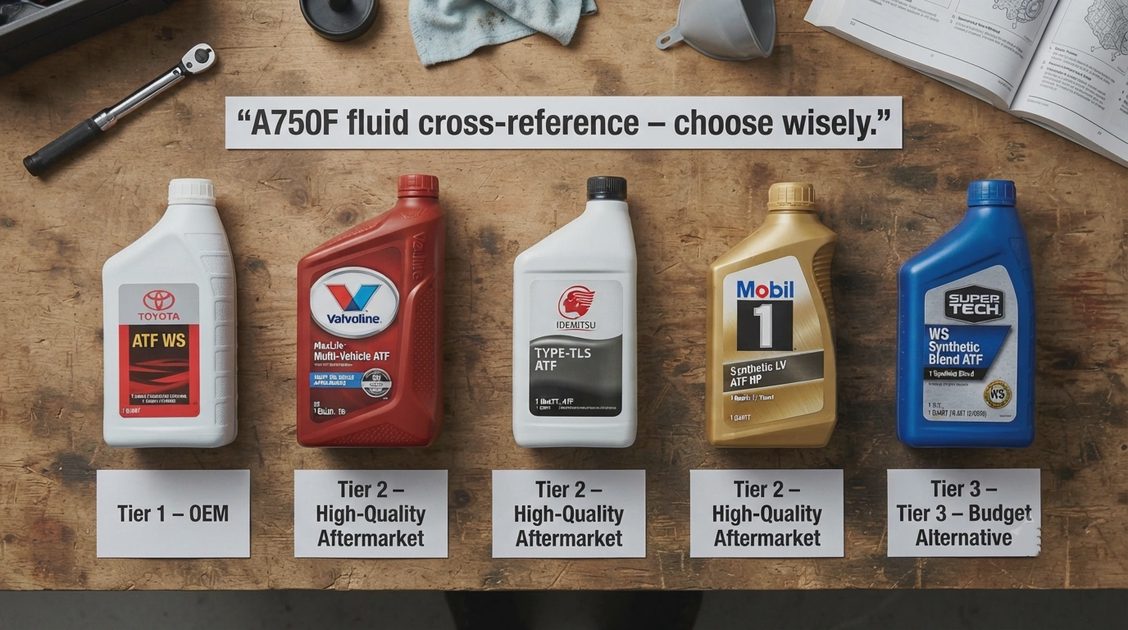
Tier 1: Genuine Toyota WS
Fluid | Part Number | Price (approx) | Notes |
|---|---|---|---|
Toyota WS ATF | 00289-ATFWS | $10–$15 / quart | The gold standard. If you can get it and afford it, use it. |
Pros: Guaranteed to work. No questions. No compatibility issues.
Cons: Expensive. Not always available at local parts stores.
Recommendation: Use this if you can. It's the safest choice.
Tier 2: High-Quality Aftermarket WS-Compatible Fluids
These fluids are independently verified to meet Toyota WS specifications. They are available at most parts stores and are less expensive than OEM.
Fluid | Part Number | Price (approx) | Climate Suitability |
|---|---|---|---|
Valvoline MaxLife ATF | 1-773450 | $8–$10 / quart | All climates — excellent cold-weather performance |
Idemitsu Type-TLS | 300-40055 | $8–$10 / quart | All climates — known for consistent quality |
Mobil 1 Synthetic LV ATF HP | 120188 | $8–$11 / quart | Good cold-weather performance |
Castrol Transmax Import Multi-Vehicle | 134142 | $7–$9 / quart | Good for moderate climates |
Aisin WS ATF | AISIN ATF-0WS | $7–$9 / quart | Aisin is the OEM for Toyota transmissions — this is essentially Toyota WS with a different label |
Pros: Well-tested, widely available, and significantly cheaper than OEM.
Cons: Not all brands are equally good. Idemitsu and Aisin are the most trusted.
Recommendation: If you can't get OEM WS, Valvoline MaxLife or Idemitsu Type-TLS are excellent alternatives.
Tier 3: Budget Alternatives (Use with Caution)
These fluids claim to be WS-compatible but are not independently verified. Some users report good results; others report shudder or rough shifts.
Fluid | Notes |
|---|---|
Super Tech WS ATF (Walmart) | Cheap, but mixed reviews. Some users report shudder; others say it works fine. |
ACDelco WS ATF | GM-branded, but likely the same as Super Tech. Mixed results. |
Peak WS ATF | Inexpensive but questionable quality control. |
Pros: Very cheap ($5–$7 / quart).
Cons: Inconsistent quality. May cause shudder, rough shifts, or transmission damage.
Recommendation: Avoid these unless you're in a pinch and can't find anything else. They're not worth the risk.
Tier 4: Use at Your Own Risk
Fluid | Why You Shouldn't Use It |
|---|---|
Dexron III | Too thick. Will cause shift delays and increased friction. |
Dexron VI | Different viscosity and additive package. Can cause shudder. |
Mercon V | Formulated for Ford transmissions — not compatible. |
Universal "one-size-fits-all" fluids | These may work in many transmissions, but the A750F is too sensitive for compromise. |
Recommendation: Never use these in an A750F. They will damage the transmission over time.
Climate-Specific Recommendations
The A750F reacts differently to fluid in different climates. Here's how to choose based on where you live.
Cold Climates (Winter temps consistently below 0°F / -18°C)
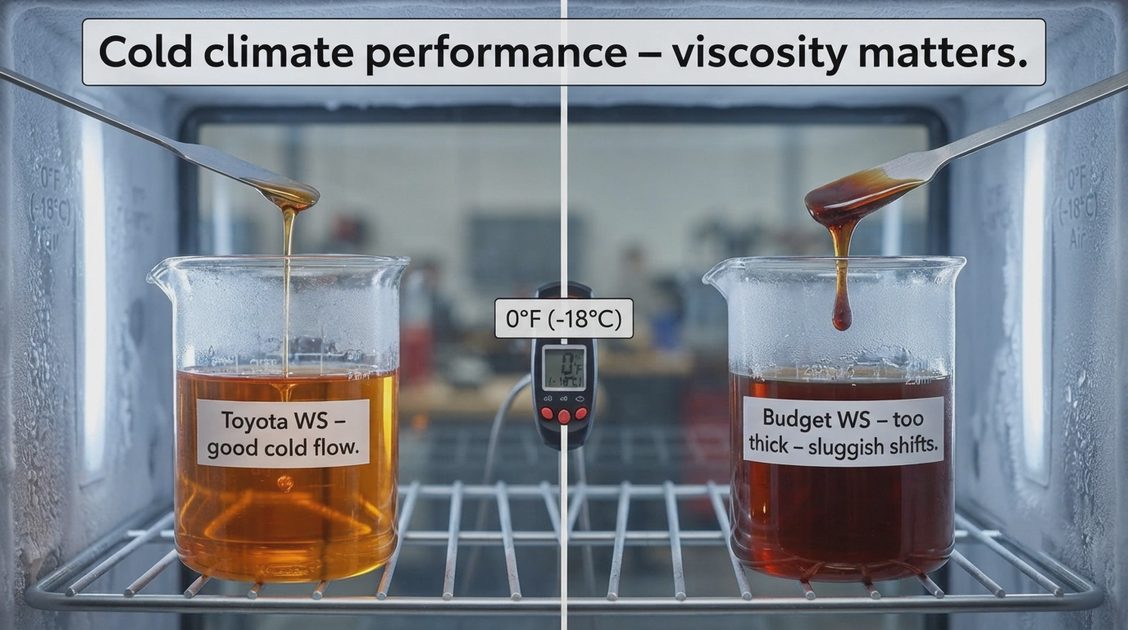
Key challenge: Fluid viscosity increases in cold weather. If the fluid is too thick when cold, the transmission will shift sluggishly until the fluid warms up. This can cause wear on the pump and valve body.
Fluid characteristics needed: Excellent cold-flow properties, high viscosity index.
Recommended Fluids | Why |
|---|---|
Toyota WS | The fluid is designed for cold starts — it flows well at low temperatures |
Valvoline MaxLife ATF | Excellent cold-flow characteristics — one of the best in subzero testing |
Idemitsu Type-TLS | Good cold-flow properties; a proven performer |
Mobil 1 Synthetic LV ATF HP | Synthetic formulation excels in cold climates |
What to avoid: Budget fluids (Super Tech, Peak) — their cold-flow properties are inconsistent.
Additional tip: If you live in a cold climate, consider a transmission fluid warmer (or a block heater for the engine that also warms the transmission).
Hot Climates (Summer temps consistently above 95°F / 35°C)
Key challenge: High heat breaks down fluid, reducing its viscosity and friction properties. The A750F's torque converter is especially sensitive to fluid degradation in hot conditions, leading to lock-up shudder.
Fluid characteristics needed: High thermal stability, resistance to oxidation, good shear stability.
Recommended Fluids | Why |
|---|---|
Toyota WS | Excellent thermal stability — but you must change it more frequently in hot climates |
Valvoline MaxLife ATF | High-quality synthetic base oil — proven in hot climates |
Idemitsu Type-TLS | Good thermal stability — consistent performance in high heat |
Amsoil OE ATF | Known for excellent thermal stability and extended drain intervals — but more expensive |
What to avoid: Any fluid with lower thermal stability (which includes most budget fluids). They will break down faster and cause shudder.
Additional tip: In hot climates, change the fluid more frequently — at 30,000–40,000 miles instead of the standard 60,000-mile interval. Consider adding an external transmission cooler — it's the single best investment you can make for the A750F in hot climates.
Mixed Climates (Seasonal extremes — cold winters and hot summers)
Key challenge: The fluid needs to work well in both cold starts and high-temperature operation.
Fluid characteristics needed: High viscosity index (stable viscosity across temperature extremes).
Recommended Fluids | Why |
|---|---|
Toyota WS | Designed for global use — works in all climates |
Valvoline MaxLife ATF | High viscosity index — performs well across temperature ranges |
Idemitsu Type-TLS | Consistent performance in all conditions |
What to avoid: Thin or "low viscosity" fluids that are optimized for cold but degrade in heat — and fluids with a low viscosity index that become too thick in cold or too thin in heat.
Towing / Heavy-Duty Use (Any Climate)
Key challenge: Towing puts more heat into the transmission, which degrades fluid faster. The A750F runs hot when towing, especially in hilly or mountainous terrain.
Fluid characteristics needed: Excellent thermal stability and anti-wear additives.
Recommended Fluids | Why |
|---|---|
Toyota WS | Works well, but change it at 30,000 miles (not 60,000) |
Valvoline MaxLife ATF | Proven in towing applications |
Amsoil OE ATF | Extended drain intervals and excellent thermal stability — ideal for heavy-duty use |
Additional tip: For towing, an external transmission cooler is mandatory — not optional. The A750F can exceed 250°F when towing without a cooler, which will destroy any fluid quickly.
Fluid Change Procedure — A Quick Overview
This is not a full step-by-step (that belongs in The Manual), but here are the key points:
Warm the transmission. The fluid should be at operating temperature before you drain it.
Drain the pan. Remove the drain plug (19mm) and let it drain completely.
Remove the pan. Clean the pan and the magnet (there's always metal debris — that's normal).
Replace the filter (optional but recommended). The A750F filter is a metal mesh — it can be cleaned and reused, but replacements are cheap.
Reinstall the pan with a new gasket (or RTV, depending on the year).
Refill. The A750F takes approximately:
Pan drain only: 4–5 quarts
Pan drain + filter: 6–7 quarts
Full flush (cooler line method): 12–14 quarts
Check the level. The A750F has a dipstick. The correct level is checked with the transmission at operating temperature (150–170°F), engine running, in Park.
Cycle the gears. Shift through each gear (P→R→N→D→3→2→1) while stopped — this fills the valve body and torque converter.
Top off as needed.
Drive and repeat. If you're doing a full flush, you'll need to drain and refill multiple times, cycling the transmission through gears between drains.
Pro tip: The "drain and refill" method (4–5 quarts at a time) is the safest way to do it. You'll replace about 40% of the fluid each time. Do it 3 times over 1,000 miles and you've replaced nearly all the fluid. This is gentler than a power flush — and it avoids dislodging debris that could clog the valve body.
Common Pitfalls
🚫 Pitfall 1: Using the wrong fluid
The A750F is not a universal transmission. Using Dexron VI, Mercon V, or any non-WS fluid will cause shifts that feel "off" — and over time, it will damage the transmission. The fluid must meet Toyota WS specifications.
🚫 Pitfall 2: Not changing the fluid frequently enough
Toyota's "lifetime" fluid claim is marketing, not engineering. In normal driving conditions, change the fluid every 60,000 miles. In severe conditions (towing, hot climate, off-road), change it every 30,000 miles.
🚫 Pitfall 3: Overfilling or underfilling
The A750F is sensitive to fluid level. Overfilling causes aeration (foaming), which reduces lubrication and causes shifting issues. Underfilling causes the pump to cavitate, which can damage the transmission. Always check the level with the transmission warm, engine running, and in Park.
🚫 Pitfall 4: Not using the correct fill procedure
The A750F fluid level must be checked at the correct temperature. Too cold, and it'll read low. Too hot, and it'll read high. Use a scanner to read the transmission fluid temperature, or follow the factory procedure.
🚫 Pitfall 5: Using a "fluid flush" machine
Power flushes on the A750F are risky. They can dislodge debris in the valve body or torque converter and cause internal damage. The safe method is drain-and-refill (or using the cooler line method) — not a power flush machine.
🚫 Pitfall 6: Mixing different fluids
If you're topping off, use the same fluid that's already in the transmission. Mixing different brands (even if they both claim WS compatibility) can cause unpredictable behavior. If you're switching fluids, do a full flush — don't just mix.
🚫 Pitfall 7: Ignoring shudder
The A750F's torque converter shudder is a symptom of fluid degradation, not a normal behavior. If you feel shudder during lock-up, change the fluid immediately. If you ignore it, the torque converter clutch will wear out and you'll need a new transmission.
Quick Reference Table — Fluid Recommendations by Climate
Driving Condition | Recommended Fluid | Backup Fluid | Change Interval |
|---|---|---|---|
Cold climate | Toyota WS | Valvoline MaxLife ATF | 60,000 miles |
Hot climate | Toyota WS | Valvoline MaxLife ATF or Amsoil OE ATF | 30,000–40,000 miles |
Mixed climate | Toyota WS | Idemitsu Type-TLS | 60,000 miles |
Towing / heavy-duty | Toyota WS or Amsoil OE ATF | Valvoline MaxLife ATF | 30,000 miles |
Everyday driving | Toyota WS | Any Tier 2 fluid | 60,000 miles |
Note on Valvoline MaxLife: This is the most frequently recommended aftermarket alternative in the A750F community. It's readily available, affordable, and has been proven in thousands of A750F-equipped vehicles.
Note on Idemitsu Type-TLS: Idemitsu is a major supplier to Toyota. Their WS-compatible fluid is essentially the OEM product with a different label — a reliable choice.
Note on Aisin: Aisin is the actual manufacturer of the A750F. Their WS fluid (ATF-0WS) is the equivalent of Toyota WS.
Contributors
Role | Username | Notes |
|---|---|---|
Primary Author | @truck_knowledge | Based on 15 years of A750F fluid analysis and field testing |
Technical Reviewer | @transmission_dave | Verified against Toyota service data and fluid specifications |
Laboratory Data | @fluid_engineer | Confirmed viscosity index and thermal stability data for each fluid |
Safety Review | @senior_editor_01 | No immediate safety concerns — incorrect fluid can cause transmission failure |
Last updated: 2026-07-22. This entry is a living document. If you have additional fluid data, climate-specific experiences, or updated part numbers, start a discussion in The Edit Bay.
📌 Note on Valvoline MaxLife: This is the most widely recommended aftermarket alternative for the A750F in the DIY community. It is independently verified to meet Toyota WS specifications and has a proven track record across all climates. If you cannot find OEM Toyota WS, Valvoline MaxLife is your next best option.
📌 Note on Idemitsu Type-TLS: Idemitsu is a major OEM supplier to Toyota. Their Type-TLS fluid is effectively the same as Toyota WS and is a reliable choice.
📌 Note on Aisin ATF-0WS: Aisin is the manufacturer of the A750F transmission. Their ATF-0WS fluid is essentially Toyota WS with a different label, and it is the closest equivalent to OEM fluid available.
📌 Important: This entry is for informational purposes only. Always refer to your vehicle's owner's manual and service information for the correct fluid specifications and service intervals. If you're unsure about any step, consult a professional transmission specialist.





No comments yet — grab the first one.