The Problem
You spent a weekend applying that expensive epoxy garage floor kit. It looks great. It's shiny. It resists oil stains. You're proud of it.
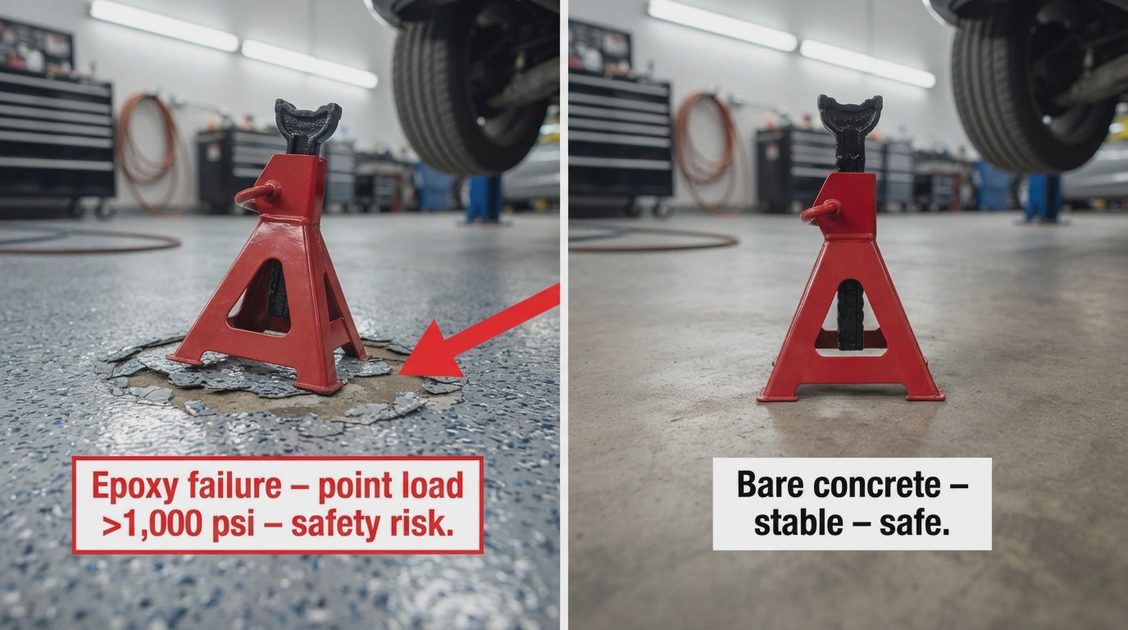
Then you put your car on jack stands. A few hours later, you pull the stands out — and you see it. A ring of cracked, peeled, or completely missing epoxy where the stand was sitting. Or worse — the stand shifted while the car was on it.
Here's the hard truth: Most garage floor coatings — including the DIY epoxy kits from the big box stores — are not designed for the point loads that jack stands create. A jack stand's feet are small. Your car weighs 2,500–5,000 pounds. That weight concentrated on four small points creates pressure that can exceed 1,000 psi. Most epoxy coatings fail at a fraction of that.
And it gets worse: When the coating fails under the stand, the stand can shift, tilt, or sink unevenly. A car falling off jack stands is not a "whoops" moment. It's a trip to the hospital — or worse.
This isn't about keeping your floor pretty. This is about keeping you alive.
Why Epoxy Fails Under Jack Stands
Factor | What Happens |
|---|---|
Point loading | Jack stands concentrate the car's weight onto small feet. The pressure can exceed 1,000 psi — well beyond what most epoxy coatings can handle. |
Lack of flexibility | Epoxy is rigid. When you place a heavy load on it, it doesn't compress — it cracks or delaminates from the concrete. |
Poor adhesion | DIY kits often have marginal adhesion to the concrete. The weight of the car can pull the coating right off the surface. |
Heat cycling | If you just drove the car, the floor is warm from the exhaust or engine heat. Epoxy softens when warm. The jack stand sinks in. |
Chemical attack | Some epoxy formulations soften when exposed to oils or solvents. Jack stands often have oil on them. It's a cycle. |
The result: The epoxy fails under the stand. The stand shifts. The car moves. Your safety is compromised.
The Right Way — Flooring That Actually Works Under Jack Stands
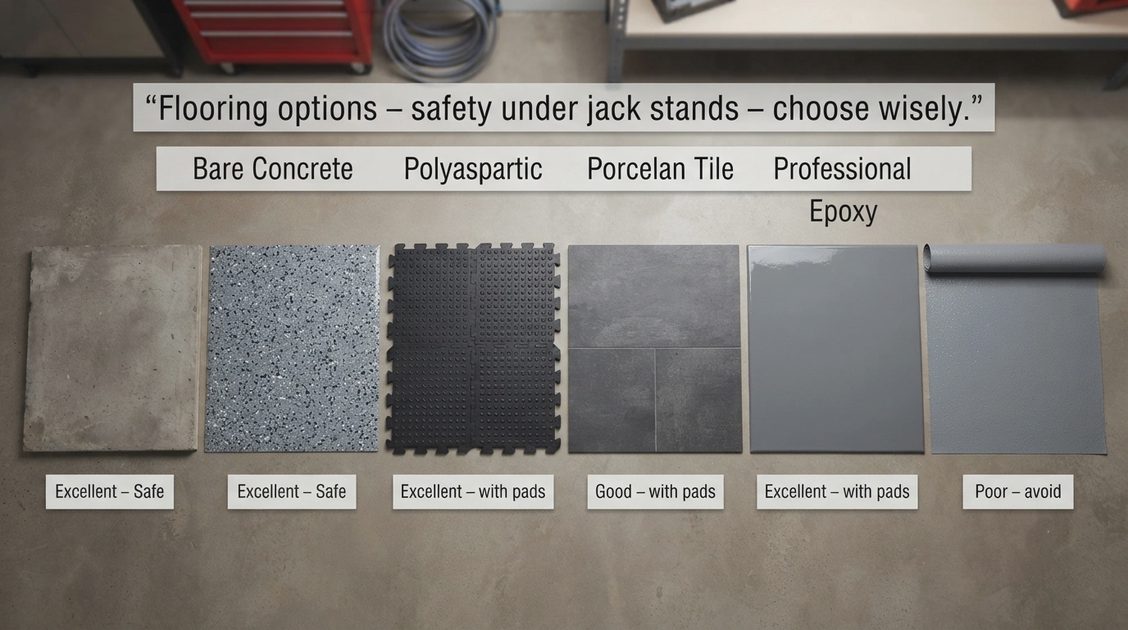
Here's what works — ranked from best to worst (but still acceptable).
Option 1: Bare Concrete (Honestly, It's Fine)
Feature | What It Means |
|---|---|
Pros | 100% stable, no coatings to fail, maximum grip for jack stands, zero cost |
Cons | Stains easily, hard to clean, looks "industrial" |
Cost | $0 |
The truth: Bare concrete is the safest surface for jack stands. The stands grip the concrete directly. There's no coating to crack, no layer to peel, no surface to shift. The jack stand's feet are designed to work on concrete. Concrete is the reference standard.
Is it pretty? No. Is it safe? Yes.
Recommendation: If you have bare concrete, don't feel pressured to coat it. A stained, oil-marked floor is still safer than a pretty floor that fails under a loaded car. If you want the best of both worlds, clean the concrete and seal it with a penetrating sealer (not a coating) — this keeps stains out while keeping the surface texture intact.
Option 2: Polyaspartic / Polyurea Floor Coatings
Feature | What It Means |
|---|---|
Pros | Much more durable than epoxy, better adhesion, more flexible |
Cons | More expensive, usually requires professional installation |
Cost | $4–$8 per square foot installed |
Jack stand performance | Excellent — with one caveat (see below) |
Why it works: Polyaspartic and polyurea coatings are much more flexible than epoxy. They can handle point loads without cracking or delaminating. They also bond better to concrete and are more resistant to heat and chemicals.
The caveat: Even with polyaspartic, you should still use rubber or urethane jack stand pads (see Accessories section below). The coating is tough, but it's not invincible. Pads distribute the load and protect the coating.
Recommendation: If you're going to coat your floor and you work on cars regularly, spend the extra money on polyaspartic. Skip the DIY epoxy kits. This is one of those "buy once, cry once" situations.
Option 3: Rubber Garage Flooring (Interlocking Tiles)
Feature | What It Means |
|---|---|
Pros | Excellent grip, very durable, easy to replace individual tiles, comfortable to stand on |
Cons | Expensive, can trap moisture underneath, hard to clean if liquids get under them |
Cost | $4–$8 per square foot for good quality |
Jack stand performance | Excellent — if you buy the right product |
Why it works: Rubber flooring compresses slightly under load, which distributes the weight of the jack stand over a larger area. It also provides excellent grip — the stand won't slide.
The catch: You need solid rubber tiles, not the perforated drainage tiles (which are designed for wet areas, not load-bearing). You also need a floor that's flat — if the concrete is uneven, the tiles will shift under load.
Recommendation: If you work on cars regularly and want a floor that's comfortable to stand on, rubber tiles are a great option. Just make sure you buy ones that are rated for heavy point loads.
Option 4: Porcelain or Ceramic Tile
Feature | What It Means |
|---|---|
Pros | Extremely durable, chemical resistant, easy to clean, looks great |
Cons | Expensive, requires professional installation, very hard (not comfortable) |
Cost | $5–$15 per square foot installed |
Jack stand performance | Excellent — but you must use jack stand pads |
Why it works: Porcelain tile is incredibly strong. It can handle point loads without cracking — if it's installed properly and if you're not dropping things on it.
The catch: You need rectified porcelain (the edges are perfectly straight, creating a tight grout line). You need a thinset that's fully cured (not the cheap stuff). And you must use jack stand pads to prevent scratching or chipping the surface.
Recommendation: If you're building a show garage and you want it to look amazing, porcelain tile is the way to go. But it's not the most practical option for a working garage. And if you drop a heavy tool on it, you might crack a tile.
Option 5: High-Quality Epoxy (Professional, Not DIY)
Feature | What It Means |
|---|---|
Pros | Durable, chemical resistant, looks great |
Cons | Expensive, still needs pads for jack stands |
Cost | $6–$10 per square foot installed |
Jack stand performance | Good — with pads |
Why it works: Professional epoxy coatings (100% solids, high-build) are much more durable than DIY kits. They're applied in thicker coats and bond better to the concrete.
The caveat: Even professional epoxy will eventually fail under jack stand point loads if you don't use pads. The coating is tough, but 1,000+ psi on a small area will eventually cause it to crack or delaminate.
Recommendation: If you want epoxy, get a professional installation. Use jack stand pads. And accept that even the best epoxy will need occasional touch-ups where the stands sit.
Option 6: DIY Epoxy Kits (The One to Avoid)
Feature | What It Means |
|---|---|
Pros | Cheap, easy to apply, looks good initially |
Cons | Fails under jack stand loads, poor adhesion, prone to peeling |
Cost | $150–$300 for a 2-car garage |
Jack stand performance | Poor — not recommended |
Why it fails: DIY epoxy kits are typically water-based or low-solids. They go on thin. They don't bond well to concrete (especially if the concrete wasn't perfectly prepared). When you put a heavy point load on them, they crack, peel, or delaminate.
The result: Jack stands sink into the coating, shift, or the coating peels up around the stand feet. Your safety is compromised.
Recommendation: If you already have a DIY epoxy floor, don't use it as-is for jack stands. Put down plywood, rubber pads, or metal load-spreading plates under the stands (see Accessories below). It's not ideal, but it's safer than putting a stand directly on failing epoxy.
The Accessories — What to Put Under Your Jack Stands
Product | What It Does | Cost |
|---|---|---|
Rubber jack stand pads | Sits between the stand foot and the floor. Distributes the load over a larger area. Protects the floor. | $15–$30 per set of 4 |
Urethane jack stand pads | Same as rubber, but more durable and oil-resistant. | $20–$40 per set of 4 |
3/4" plywood squares | Distributes the load over a much larger area. Cheap. Works well. | $10–$20 |
Metal load-spreading plates | Aluminum or steel plates that sit under the stand. Protects the floor and stabilizes the stand. | $30–$50 per set of 4 |
Horse stall mats | 3/4" thick rubber. Cut them into pieces and place under the stands. Very durable. | $40–$60 per 4x6' mat |
Masonite / hardboard | Smooth, hard surface. Works well on coated floors to prevent scratching. | $10 per 4x8' sheet |
The best combination: Jack stand pads (rubber or urethane) + 3/4" plywood — the plywood spreads the load across the floor, and the pads protect the floor from scratches and give the stand better grip. This combination works on any floor surface and costs under $40.
Important: Don't use pucks or hockey pucks as jack stand pads. They're too hard and can slip. There are documented cases of cars falling off jack stands that were sitting on hockey pucks. Use purpose-designed rubber or urethane pads — they're cheap and designed for the job.
What to Do If You Already Have Epoxy
If you already have a DIY epoxy floor and you can't (or don't want to) replace it, here's how to safely put a car on jack stands:
Step 1: Cut four pieces of 3/4" plywood — approximately 12" x 12" each.
Step 2: Place the plywood squares under the jack stand locations.
Step 3: Place jack stand pads on the plywood, or place the stands directly on the plywood.
Step 4: Place the jack stands on the pads or plywood.
Step 5: After jacking the car and setting it on the stands, shake the car gently from side to side. It should not move. If it rocks, re-position the stands.
Step 6: Check the stands after 10 minutes — if the epoxy is soft or the plywood is sinking, get the car down and use a different floor area.
The plywood spreads the load over 144 square inches instead of the stand's 4–6 square inches. This reduces the pressure on the epoxy by a factor of 20–30. The epoxy won't fail under that load.
Common Pitfalls
🚫 Pitfall 1: Putting jack stands directly on epoxy
This is a mistake. Even if the epoxy doesn't fail immediately, it will over time. And if it fails while the car is on the stands, you're in serious trouble. Always use pads or plywood.
🚫 Pitfall 2: Using jack stands on wet or oily floors
Jack stands need traction. If the floor is wet (water, oil, or coolant), the stands can slide. Clean the floor before putting a car on stands. If you can't clean it, put down plywood or rubber mats first.
🚫 Pitfall 3: Using the wrong thickness of plywood
1/2" plywood will crack under a car's weight. You need 3/4" minimum. 5/8" can work, but 3/4" is the standard for load-spreading.
🚫 Pitfall 4: Not checking the stands after the first few minutes
Epoxy softens under pressure and heat. The first few minutes of the car being on stands is when the epoxy will fail. Check the stands after 5 minutes, 10 minutes, and 30 minutes. If anything is moving, take the car down.
🚫 Pitfall 5: Using hockey pucks as jack stand pads
This is dangerous. Hockey pucks are too hard and can slip. They have caused documented accidents. Use purpose-designed rubber or urethane pads.
🚫 Pitfall 6: Putting stands on cracked or damaged concrete
The floor has to be sound. If the concrete is cracked or spalling, the stands won't be stable. Fix the concrete (or put down plywood) before working on the car.
🚫 Pitfall 7: Using a "pretty" floor instead of a safe one
Your garage floor is your workspace, not a showroom. Safety is more important than aesthetics. If you have to choose between a bare concrete floor that's safe and a coated floor that's pretty but dangerous, choose the bare concrete.
Quick Reference — Flooring Options
Flooring Type | Jack Stand Safety | Cost Per Sq Ft | Recommended? |
|---|---|---|---|
Bare concrete | Excellent | $0 | ✅ Yes — the safest option |
Polyaspartic | Excellent (with pads) | $4–$8 | ✅ Yes — if you want a coating |
Rubber tiles | Excellent (solid tiles) | $4–$8 | ✅ Yes — comfortable and durable |
Porcelain tile | Excellent (with pads) | $5–$15 | ✅ Yes — but more for show garages |
Professional epoxy | Good (with pads) | $6–$10 | ⚠️ Yes, but only with pads |
DIY epoxy | Poor — prone to failure | $2–$4 | ❌ No — avoid for working garages |
Concrete sealer | Excellent | $0.5–$1 | ✅ Yes — if you want stain protection |
The Bottom Line
Your garage floor is not a showroom. It's a workspace. Safety matters more than aesthetics.
If you have a DIY epoxy floor:
Use 3/4" plywood squares or rubber jack stand pads under every stand.
Check the stands after a few minutes — if the epoxy is failing, get the car off the stands immediately.
If you're planning to coat your garage floor:
Skip the DIY epoxy kits. They're not designed for point loads.
Use polyaspartic, polyurea, or rubber tiles — they're much more durable.
Budget for rubber or urethane jack stand pads — they're part of the system.
If you have bare concrete:
Keep it. It's safe. It's the reference standard.
If you want stain protection, use a penetrating sealer (not a coating).
Remember: A car falling off jack stands is a life-threatening event. Don't let a $200 epoxy kit put you at risk. Use the right floor — or the right accessories — and stay safe.
Contributors
Role | Username | Notes |
|---|---|---|
Primary Author | @tool_junkie | Based on 20+ years of working on cars in garages with every floor type |
Technical Reviewer | @shop_foreman | Verified coating failure data and jack stand safety protocols |
Safety Review | @senior_editor_01 | Safety Critical flag approved — structural failure under jack stands can be fatal |


No comments yet — grab the first one.