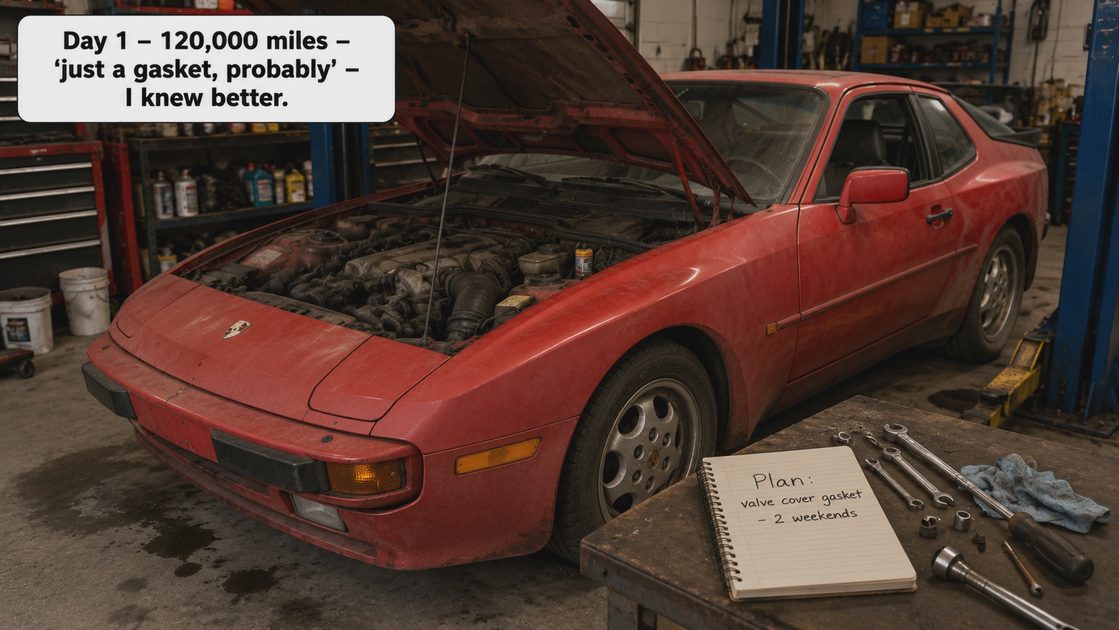
Day 1 — The Purchase (June 2024)
I bought the car on a Tuesday afternoon. A 1987 Porsche 944, Guards Red, 120,000 miles on the clock. The paint was faded but intact. The interior smelled like old leather and regret. The engine ran — sort of. It idled rough. It smoked. It had a significant oil leak that the seller described as "just a gasket, probably."
I knew better. I bought it anyway.
The price was right. The car was mostly complete. And I'd always wanted a 944 — that perfect 50/50 weight distribution, the transaxle layout, the pop-up headlights. It was a project. Projects are supposed to be fun.
I towed it home, parked it in the garage, and made a plan. The plan was simple: replace the valve cover gasket, maybe the oil pan gasket, and call it done. Drive it for the summer.
What I thought: Two weekends. Maybe three.
What actually happened: Eighteen months, an engine-out rebuild, and a significant amount of my sanity.
Week 1 — The Discovery
I started with the valve cover gasket. The old one was hard as plastic, cracked in three places. The job went smooth. Cleaned the sealing surfaces, applied a new gasket, torqued everything to spec.
Started the car. Still smoking. Still leaking.
I got under the car with a flashlight and traced the leak. It wasn't the valve cover. It wasn't the oil pan. It was coming from the back of the engine — the area where the crankshaft exits the block.
Rear main seal. Of course.
On most cars, the rear main seal is a manageable job. Drop the transmission, pull the flywheel, pop out the old seal, press in the new one. On a 944, it's worse — much worse. The engine and transmission are so tightly packed that you can't get to the flywheel without dropping the entire powertrain. And once the powertrain is out, you're looking at an engine that was designed in the 1970s, with seals that are four decades old, and you start asking yourself: "If I have to take all of this apart, what else should I replace while I'm in there?"
That question is the gateway drug of project car ownership. It starts with one seal. It ends with a complete engine reseal, a timing belt, a water pump, a clutch, and a new set of fuel lines.
I said no. I'd just do the rear main seal. Nothing else.
Month 2 — The Engine Comes Out (August 2024)
I spent a Saturday dropping the transmission. The 944's torque tube — a long, hollow shaft that connects the transmission to the transaxle — is awkward and heavy. I fought with it for hours. The exhaust had to come off. The heat shields had to come off. The starter had to come off. Every bolt was rusted.
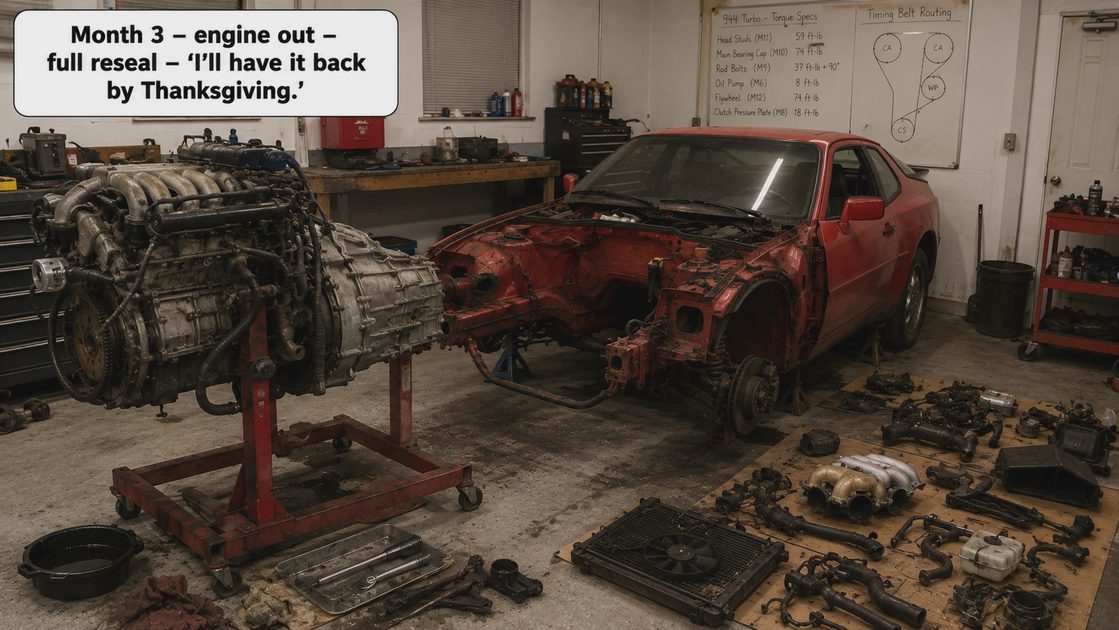
By Sunday evening, the transmission was on the floor. I looked at the flywheel. I looked at the rear main seal. And then I looked at the rest of the engine — all the oil-soaked seals, the cracked vacuum lines, the original 1987 timing belt.
The thought hit me: "If I put this all back together without replacing that timing belt, it will break in 5,000 miles and I will have to do this job again."
I walked out of the garage and didn't come back for three weeks.
Month 3 — The Engine-Out Decision (September 2024)
Here's the thing about pulling the engine on a 944: it's not that hard. The front of the car is designed for it — the radiator comes out, the front bumper comes off, and the engine slides forward and out through the front.
But that also means the entire front suspension, the cooling system, and the power steering lines have to come off. It's a cascade of disassembly. You start with one thing and you end up with a pile of parts that fills a garage.
I made the call: engine comes out. Full reseal. Timing belt, water pump, balance shaft belts, all the seals, and the clutch while I'm at it.
Famous last words: "I'll have it back together by Thanksgiving."
Month 4 — The Tear-Down (October 2024)
With the engine on a stand, I started stripping it down. The intake manifold came off. The exhaust manifold. The camshaft housing. Everything was covered in a layer of old oil and grime. The 944's M44 engine uses a balance shaft system — two counter-rotating shafts that cancel out vibration — and the belt that drives them is notoriously fussy. If you don't tension it correctly, the engine shakes itself apart.
I labeled everything. Baggies for bolts. Photos on my phone. A whiteboard on the wall with torque specs and belt routing diagrams. I felt organized. In control.
The seals were all bad. Every single one. The camshaft seals were weeping. The intermediate shaft seal was leaking. The oil cooler seals were hard as rocks. The balance shaft seals were in pieces.
I ordered a complete seal kit from Pelican Parts. While I waited, I cleaned parts. Days of degreaser, wire brushes, and brake cleaner. It was the most satisfying part of the project — seeing clean metal where there used to be sludge.
Month 6 — The Setback (December 2024)
December came. The car was still on jack stands. The engine was still on the stand. The parts I ordered arrived, but a few were backordered — the clutch kit, specifically.
So I started reassembling what I could. New timing belt. New balance shaft belts. Torquing everything to spec. Following the service manual step by step.
Then I broke a bolt.
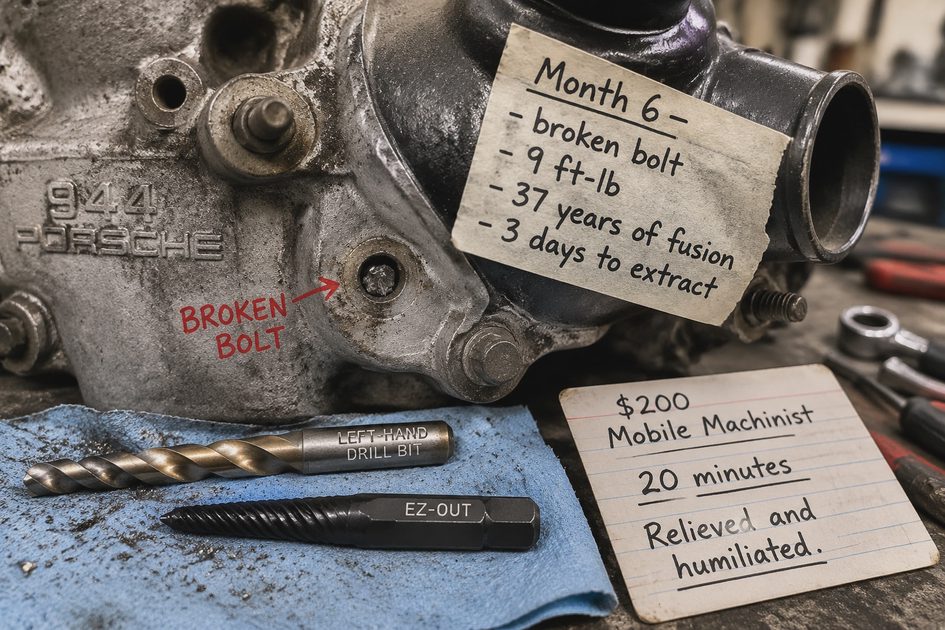
It was a thermostat housing bolt — M6, small, harmless-looking. I was torquing it to 9 ft-lb, which is nothing. It snapped clean off. The broken end was flush with the block.
I spent three days trying to extract it. Left-hand drill bits. EZ-Outs. Penetrating oil. Heat. Nothing worked. The bolt had been in the aluminum block for 37 years and had fused itself to the threads.
Eventually, I called a mobile machinist. He charged me $200 to come to my garage and use a carbide drill bit to carefully remove the bolt. He was done in 20 minutes. He looked at me with the professional's mild amusement and said, "You could have bought a Heli-Coil kit for $30 and done it yourself, but this is faster."
I felt both relieved and humiliated.
Month 8 — The Clutch (February 2025)
With the engine back together, I turned to the clutch. The old one was worn — 87,000 miles on it, according to the service records I found in the glovebox. I'd ordered a Sachs performance clutch kit, which was supposed to be a direct replacement.
It wasn't.
The kit included a pressure plate, a disc, and a throwout bearing. But the throwout bearing was the wrong size — it was too tall. After a week of emailing suppliers and comparing part numbers, I learned that the 1987 model year has a specific clutch release arm geometry that's different from the earlier and later years.
I returned the kit and ordered the correct OEM-spec parts from a Porsche specialist in California. They arrived two weeks later. This time, everything fit.
Installing the clutch on a 944 is not fun. The torque tube makes it impossible to use a standard clutch alignment tool — you have to rig something up, or just eyeball it and hope. I spent an afternoon aligning the clutch disc, dropping the transmission back in, and torquing the pressure plate bolts to spec.
It was fine. It worked.
Month 10 — The Reassembly (April 2025)
Spring came. The engine went back into the car — a two-person job that my wife generously helped with. It slid into place easier than I expected.
I started reassembling the accessories. The power steering pump. The alternator. The coolant hoses. The intake manifold. Every single one was a small puzzle: "What goes where? Which bolt is this? Why did I put that there?"
The whiteboard on the wall helped. The photos on my phone helped. The service manual helped. But there were still moments of standing in the garage, covered in grease, staring at a bracket and wondering where it was supposed to go.
The hoses were the worst. The 944's coolant hoses are integrated into a multi-port system that looks like someone designed it as a prank. One wrong connection and the engine overheats. I spent a Saturday carefully verifying each hose's routing against the manual.
By the end of April, the engine was almost fully assembled. I installed the new fuel lines — this is a critical job on 944s; the original rubber lines degrade and cause fires. I replaced the injector seals. I installed the spark plugs and wires.
It was ready to start.
Month 11 — The First Start (May 2025)
This was the moment I'd been working toward for ten months.
I checked the oil. Checked the coolant. Connected the battery. Turned the key.
It cranked. And cranked. And cranked.
Nothing.
I checked the fuel pump — it was fine. Checked for spark — it was fine. Checked the timing — it was fine. But the engine wouldn't fire.
I spent a week diagnosing a problem I couldn't find. Pulled the plugs, cleaned them, tested the ignition coil, checked the DME (the 944's engine computer), tested the speed and reference sensors. Everything tested fine. Everything should have worked. But it didn't.
On a whim, I pulled a spark plug, grounded it against the valve cover, and cranked it. There was spark. So it wasn't the ignition system.
I pulled the fuel rail, cranked the engine, and watched the injectors. No fuel. The injectors weren't firing.
The DME was the problem. The 944's DME has a common failure mode: the capacitors leak and damage the circuit board. I sent it to a specialist in Florida who rebuilt it for $200. He shipped it back in a week.
I reinstalled it, turned the key, and the engine fired on the second crank.
It was loud. It was smoky. It was beautiful.
Month 12 — The Running-In Period (June 2025)
With the engine running, I started the process of breaking it in. The new timing belt needed a retension after the first heat cycle. The coolant needed bleeding. The oil needed changing after the first 50 miles.
I drove it around the block — no plates, no insurance, just around the neighborhood. It felt amazing. The clutch was smooth. The engine was quiet. No oil leaks.
I drove it to work once, on a quiet Saturday, just to see how it felt at highway speed. It was perfect.
Then the alternator failed. Thirty-seven years old, and it gave up.
I replaced it. Then the power steering pump started whining. I replaced the O-rings and flushed the fluid. Then the temp gauge stopped working. I replaced the sensor.
Every drive was a test of something new. But the car was running. It was driving. It was a car again.
Month 18 — The Finish Line (December 2025)
It took two years. Two years of weekend work, evenings in the garage, and one very patient spouse. Two years of setbacks, failures, and small victories. Two years of learning what a 944 is — not a car you maintain, but a car you negotiate with.
Today, it's back on the road. It's not perfect — the paint still needs work, the interior has cracks, and the radio doesn't work. But the engine doesn't leak. The timing belt is new. The clutch is solid. It starts, drives, and stops like it should.
I've put 1,500 miles on it since the rebuild. I've taken it on a road trip, driven it through the mountains, and parked it in the garage just to look at it.
Would I do it again? Maybe. But I'd start with a better plan and more patience.
And I'd buy a better extraction tool for broken bolts.

No comments yet — grab the first one.