The Problem
You're driving down the highway, the check engine light pops on, and your scanner spits out:
P0420 — Catalyst System Efficiency Below Threshold (Bank 1)
The first thing most parts stores will tell you? "You need a new catalytic converter."
They're wrong.
A P0420 code means the ECU has detected that the catalytic converter is no longer reducing emissions as efficiently as it should. But here's the dirty secret of the automotive repair industry: the converter itself is rarely the first thing to fail. Usually, something else killed it — or something else is fooling the ECU into thinking it's failed.
If you replace the catalytic converter without diagnosing the root cause, you'll be replacing it again in 6 months. Or worse — you'll throw $1,200 at a part and the code will still be there.
Here's the systematic approach that will save you time, money, and a second trip under the car.
What P0420 Actually Means
Before we dive into diagnosis, you need to understand what the ECU is measuring.
Component | What It Does |
|---|---|
Front (Upstream) O₂ Sensor | Measures oxygen content before the catalytic converter. Rapidly switches between rich and lean (0.1V–0.9V) — up to several times per second. This tells the ECU how to adjust fuel trims. |
Catalytic Converter | Stores oxygen during lean cycles and releases it during rich cycles, oxidizing HC and CO, reducing NOx. A healthy converter has high oxygen storage capacity. |
Rear (Downstream) O₂ Sensor | Measures oxygen content after the converter. Should be relatively stable, switching slowly compared to the front sensor. |
The ECU's Logic | The ECU compares the switching frequency of the front sensor to the rear sensor. If the rear sensor's switching rate exceeds a threshold (typically 70-80% of the front sensor's rate), the ECU flags P0420 — the converter is no longer storing enough oxygen. |
So P0420 = rear O₂ sensor is switching too fast, meaning the converter's oxygen storage capacity is degraded.
But why is it degraded? That's what we need to figure out.
The Three Tests — Do These Before Anything Else
Test 1: Verify the Oxygen Sensors
Why this comes first: A lazy or faulty upstream O₂ sensor can cause the ECU to adjust fuel trims incorrectly, leading to a rich or lean condition that damages the converter over time. A slow rear O₂ sensor can falsely trigger P0420 even if the converter is fine.
What You Need
OBD-II scanner with live data (not just code reading capability)
Ability to graph O₂ sensor voltage in real-time (most Bluetooth scanners with apps like Torque Pro can do this)
Procedure
Step 1: Warm up the engine. O₂ sensors don't function properly until they reach operating temperature (typically 600°F+). Drive the vehicle for 10 minutes, then idle.
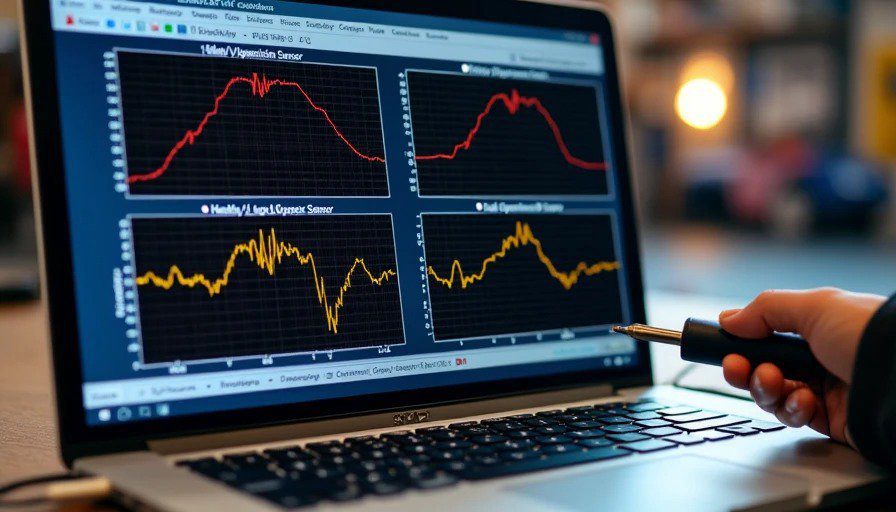
Step 2: Graph the upstream O₂ sensor (Bank 1 Sensor 1). Rev the engine to ~2500 RPM and hold it steady.
Healthy reading: Rapidly switches between 0.1V and 0.9V, multiple times per second (typically 1-5 Hz). The waveform should be clean, not flat or sluggish.
Potential issues:
Flat at 0.45V — Sensor is dead or not heating properly.
Stuck below 0.4V — Lean condition (possible vacuum leak, fuel delivery issue, or faulty sensor).
Stuck above 0.7V — Rich condition (possible injector leak, fuel pressure regulator issue, or faulty sensor).
Slow switching (< 1 Hz) — Sensor is "lazy" and needs replacement.
Step 3: Graph the downstream O₂ sensor (Bank 1 Sensor 2). Same test.
Healthy reading: Relatively stable, switching slowly (typically < 1 Hz). Voltage should remain around 0.5-0.7V under steady throttle.
Potential issues:
Switching as fast as the upstream sensor — The converter is not storing oxygen, indicating converter degradation OR the sensor is reading incorrectly.
Flat at 0.45V — Sensor is dead.
Voltage never drops below 0.6V — Running rich.
Step 4: Diagnose based on your readings:
Reading Pattern | Diagnosis |
|---|---|
Upstream sensor healthy + Downstream sensor switching slow | Converter is fine. P0420 is false. |
Upstream sensor healthy + Downstream sensor switching fast | Converter is likely degraded — but you still need Test 2 and Test 3. |
Upstream sensor lazy or stuck | Replace upstream sensor first. Clear codes and drive — P0420 may resolve. |
Downstream sensor flat at 0.45V | Replace downstream sensor. This may be your only problem. |
Pro tip: Watch the oxygen sensor waveform on a graph. A picture tells you more than voltage numbers. This is the single most valuable test you can run.
Test 2: Check for Exhaust Leaks
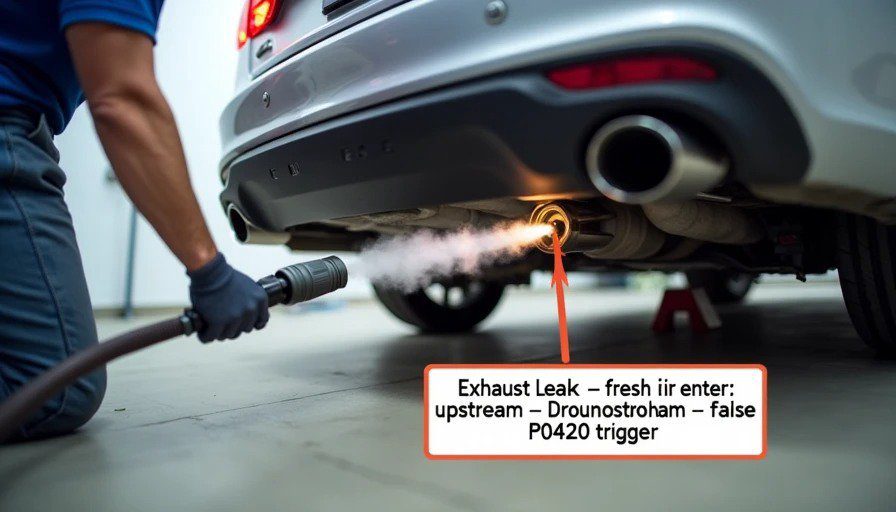
Why this comes second: An exhaust leak anywhere between the engine and the downstream O₂ sensor lets fresh air into the exhaust stream. That extra oxygen fools the downstream sensor into reading leaner than reality, which the ECU interprets as a converter that's not storing oxygen — triggering P0420.
Exhaust leaks are the #1 cause of false P0420 codes. They're also the cheapest and easiest to fix.
What You Need
Visual inspection: Flashlight, mirror on a stick, your eyeballs
Listening: Engine running, your ears (or a length of hose as a stethoscope)
Smoke test: A smoke machine (available for rent at many parts stores), a cigar, or a vape pen in a pinch
Procedure
Step 1: Visual inspection (with engine cold). Look for:
Cracks in the exhaust manifold (common on older cars)
Black soot marks around pipe joints
Rust holes in the exhaust pipes
Missing or damaged gaskets at flanges
A loose or damaged O₂ sensor bung
Step 2: Listen for leaks with the engine running. Have a helper block the tailpipe with a rag (carefully) — this builds backpressure and will make any exhaust leak louder. Listen near the manifold, the flanges, and the O₂ sensor bungs. A hissing or puffing sound indicates a leak.
Step 3: Smoke test (if you have access). This is the most definitive test:
Pressurize the exhaust system with smoke (either through a diagnostic port or the tailpipe with a plug).
Look for smoke escaping anywhere from the engine to the rear O₂ sensor.
Common leak points:
Exhaust manifold gasket (especially on cast manifolds that warp)
Manifold-to-pipe flange gasket
Any weld seam that looks questionable
O₂ sensor bungs (the sensor itself can leak if not seated properly)
Step 4: Repair any leaks you find. Even a tiny pinhole can cause P0420. Replace gaskets, tighten clamps, or weld cracks. Clear codes and drive — P0420 may resolve.
Pro tip: If you find a leak before the upstream O₂ sensor, it'll cause both sensors to read lean. If you find a leak between the sensors, it'll only affect the downstream reading. That's the one that triggers P0420.
Test 3: Check for Engine Mechanical Issues
Why this comes third: If the engine itself is misfiring, burning oil, or running rich, it's slowly destroying the catalytic converter. Replacing the converter without fixing the engine problem means you're just buying a $1,200 part that's going to be ruined again.
This is the test that most people skip — and the one that costs them a second converter.
What You Need
OBD-II scanner with live data (fuel trim, misfire counts, coolant temp)
A compression tester and spark tester (if necessary)
Procedure
Step 1: Check fuel trims. This tells you if the engine is running rich or lean:
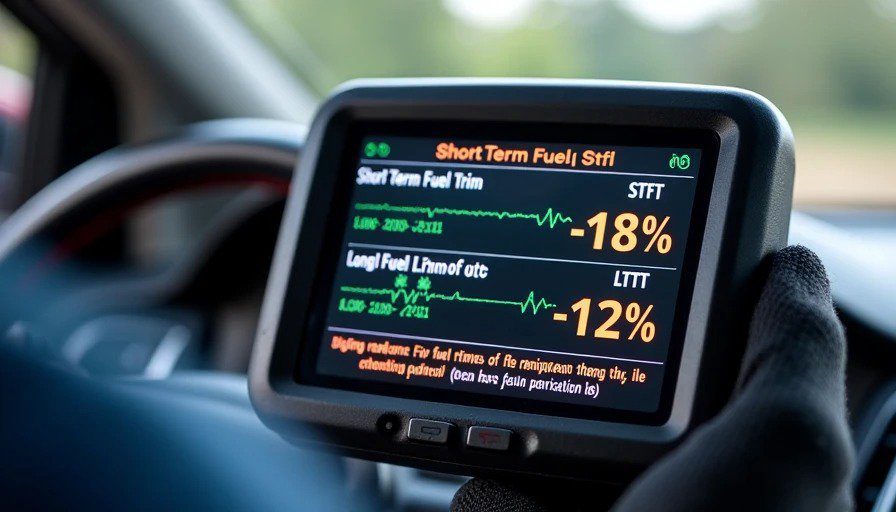
Short-Term Fuel Trim (STFT): Should fluctuate between -10% and +10% under steady driving. If it's consistently above +10% (adding fuel), the engine is running lean. If consistently below -10% (subtracting fuel), the engine is running rich.
Long-Term Fuel Trim (LTFT): Should be within ±10% at idle. Above +10% indicates a vacuum leak or low fuel pressure. Below -10% indicates leaking injectors, high fuel pressure, or a stuck coolant temp sensor.
If fuel trims are significantly out of spec (above ±15%), fix that first. A rich condition will destroy a new converter in weeks. A lean condition will reduce converter efficiency over time.
Step 2: Check for misfires. Look at the misfire counters for each cylinder:
Any cylinder showing misfires above 10+ per minute under load? That unburned fuel is hitting the converter, overheating it, and melting the substrate. Fix the misfire — plugs, coils, injectors, or compression — before you even think about a converter.
Step 3: Check engine oil consumption.
If the engine burns oil (blue smoke on startup, blue smoke on acceleration, or you're adding a quart every 1000 miles), oil is coating the converter substrate, reducing its efficiency.
Common culprits: Valve guide seals, piston rings, PCV system clogged. Address the oil consumption first, or you'll be buying two converters.
Step 4: Compression test (if you suspect an internal issue).
Low compression on one or more cylinders can cause incomplete combustion, sending unburned fuel into the exhaust.
A leakdown test can also identify if you have burned valves or worn rings.
Step 5: Verify catalytic converter temperature (if you have access to an infrared thermometer).
Run the engine at 2500 RPM for 2 minutes.
Measure the temperature at the converter's inlet and outlet (on the pipe, not the heat shield).
Healthy converter: Outlet temperature should be 50-100°F hotter than the inlet (the converter is working, burning off HC and CO).
Bad converter: Outlet is colder or the same temperature as the inlet — the converter is not doing any work.
What to Do If the Converter Is Actually Bad
If you've completed all three tests and determined:
✅ O₂ sensors are functioning properly
✅ No exhaust leaks found
✅ Engine is mechanically sound (fuel trims OK, no misfires, no oil consumption)
✅ Inlet/outlet temperature difference indicates the converter is not working
Then — and only then — replace the catalytic converter.
Replacement Tips
Consideration | What to Do |
|---|---|
OEM vs. Aftermarket | OEM converters last longer but cost more. Quality aftermarket (Walker, Magnaflow) are acceptable if you're on a budget. Avoid the really cheap eBay converters — they use less precious metal and fail quickly. |
Replace both sensors | When you replace the converter, replace the downstream O₂ sensor at the same time. The old one is likely contaminated. The upstream sensor is optional but recommended if it's been in there for 60k+ miles. |
Clear codes and drive | After replacement, clear the code and complete a drive cycle to let the ECU re-learn. |
Do the job right | A CAT replacement is a bolt-on job on most vehicles. But on some, it's welded in — you'll need an exhaust shop or a sawzall and a welder. |
Common Pitfalls
🚫 Pitfall 1: Replacing the converter without running tests
Don't do this. You're not diagnosing — you're just gambling with $1,200. Use the three-test process first. A P0420 is usually the symptom, not the disease.
🚫 Pitfall 2: Reading only voltage, not waveform
O₂ sensors are about waveform, not absolute voltage. A graphing scanner will show you if the sensor is lazy, if the waveform is clipped, or if there's a pattern that indicates a specific problem. Voltage numbers alone are misleading.
🚫 Pitfall 3: Ignoring small exhaust leaks
A tiny pinhole can cause P0420. The O₂ sensor is sensitive to a few percent of extra oxygen. If you can hear it, fix it. If you can see soot, fix it. If you're not sure, smoke-test it.
🚫 Pitfall 4: Assuming aftermarket O₂ sensors are as good as OEM
They're not. The cheap $30 sensors often have slower response times. If you're replacing sensors, buy Denso, NTK, or Bosch (OEM brands for most vehicles). The extra $20-40 per sensor is worth it.
🚫 Pitfall 5: Buying a "universal" catalytic converter
Universal converters often don't have the same precious metal loading as the direct-fit version. They fail faster. Buy the one that specifically fits your year/make/model, or have a competent shop confirm the universal is compatible.
🚫 Pitfall 6: Not addressing the root cause of converter failure
If the converter failed due to a rich condition, an oil leak, or a misfire, and you don't fix that — the new converter will fail too. It's just a matter of time. Fix the engine first, or waste your money.
Flowchart — Quick Reference
text
复制
下载
P0420 Code
     │
     ▼
Test 1: O₂ Sensors
     │
     ├── Upstream sensor lazy or dead? → Replace sensor → Retest
     │
     ├── Downstream sensor lazy or dead? → Replace sensor → Retest
     │
     ├── Both sensors good? → Continue to Test 2
     │
     ▼
Test 2: Exhaust Leaks
     │
     ├── Leak found between engine and downstream O₂? → Fix leak → Retest
     │
     ├── No leaks found? → Continue to Test 3
     │
     ▼
Test 3: Engine Mechanical
     │
     ├── Fuel trims out of spec? → Fix fuel delivery or vacuum leak
     │
     ├── Misfires detected? → Fix spark or fuel issue
     │
     ├── Oil consumption? → Address PCV/valve guides/rings
     │
     ├── All tests pass? → Converter is truly bad → Replace
     │
     ▼
Replace catalytic converter
     │
     ▼
Clear codes, drive cycle, verify no reoccurrence
Cost Comparison — A Hard Truth
Scenario | Cost | Outcome |
|---|---|---|
Replace CAT without diagnosing | $1,200 + labor | Code may return. CAT may fail again. You're out $1,200. |
Run the three tests, find an exhaust leak | $20 gasket + 1 hour | P0420 resolved. You just saved $1,100. |
Run the three tests, find a lazy O₂ sensor | $60 sensor + 30 min | P0420 resolved. You just saved $1,000. |
Run the three tests, find a misfire and fix it | $100 coils/plugs + 1 hour | P0420 may still be present, but if you've avoided replacing a good converter, you're ahead. |
Run the three tests, truly need a CAT | $800 part + labor | The correct repair. You know it's the right call. |
Contributors
Role | Username | Notes |
|---|---|---|
Primary Author | @diagnostic_dave | Based on 25+ P0420 diagnoses across Toyota, Honda, Ford, GM |
Technical Reviewer | @honda_tech_20yrs | Verified O₂ sensor switching thresholds against Toyota and Honda service manuals |
Fact Check | @smoke_test_sam | Reviewed exhaust leak detection methods |
Safety Review | @senior_editor_01 | Safety Critical flag approved — improper diagnosis can lead to wasted money, but no immediate safety risk |
References & Further Reading
Bosch Oxygen Sensor Diagnostic Guide — "The Art of Oxygen Sensor Diagnosis"
Toyota T-SB-0016-19: P0420/P0430 Diagnostic Procedure
Honda Service Bulletin 06-048: O₂ Sensor Diagnostics and Catalyst Monitoring
SAE Paper 2004-01-1279: O₂ Sensor Switching Frequency Analysis



No comments yet — grab the first one.