The Reality of Buying an NA
The Mazda MX-5 NA (1989–1997) is one of the greatest driver's cars ever built. It's light, balanced, reliable, and absurdly fun. It's also thirty years old, made of thin steel, and driven through three decades of winters, rain, and enthusiastic cornering.
Here's the truth: Every NA Miata has rust. Every single one. The question is not "does it have rust?" — the question is "how much rust does it have, and where is it hiding?"
This checklist is designed to be printed, folded, and taken with you when you go to look at a car. It's organized by the order you should inspect things — starting with the things that will kill the deal, and ending with the things you can negotiate on.
If you find a red flag in Section A, walk away. The car is not worth it.
Section A — Deal Breakers (Walk Away)
These issues are structural, expensive, or impossible to fix properly. If you find any of these, stop the inspection and walk away. There are other Miatas.
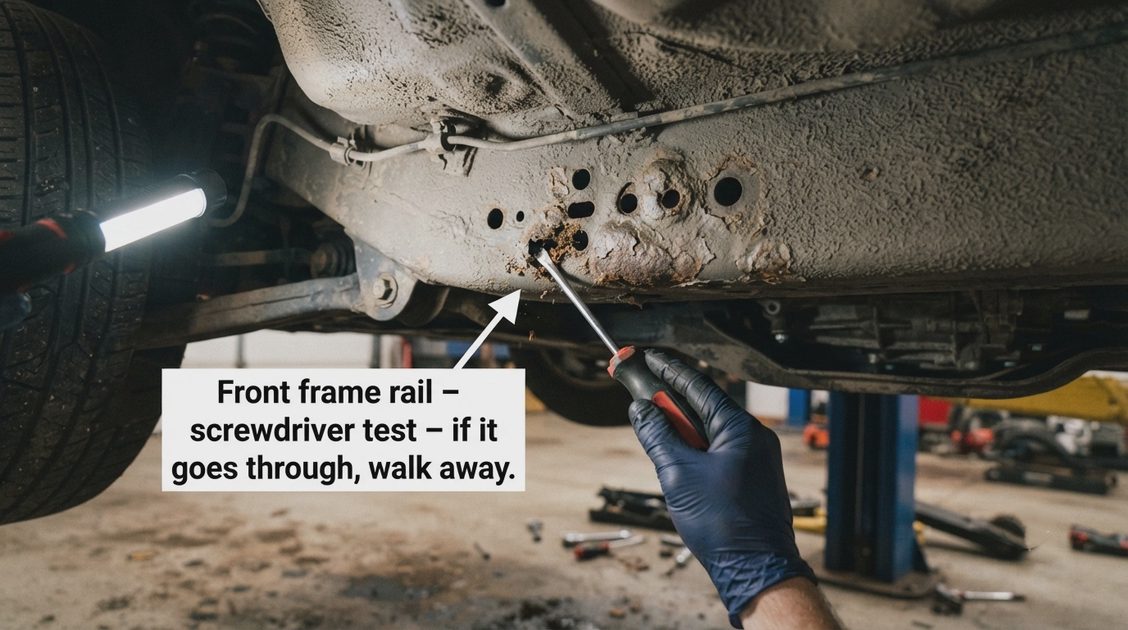
A1: Front Frame Rails (The "Smile" Holes)
Where to look: Under the car, at the front. The frame rails run from the front bumper to the firewall. On the NA, they have factory holes — but if you see rust bubbles, swelling, or holes around these openings, the frame is compromised.
What to do:
Get under the car with a flashlight.
Look at the frame rails on both sides — front to back.
Poke the rails with a screwdriver. If it goes through, walk away.
The passenger side is usually worse (the A/C drain drips onto it).
Why it matters: Rusted frame rails compromise the car's crash structure and alignment. Repairing them requires cutting and welding — $2,000+ if done properly.
Red flag: Any hole larger than a dime. Any soft spot you can push in with your finger.
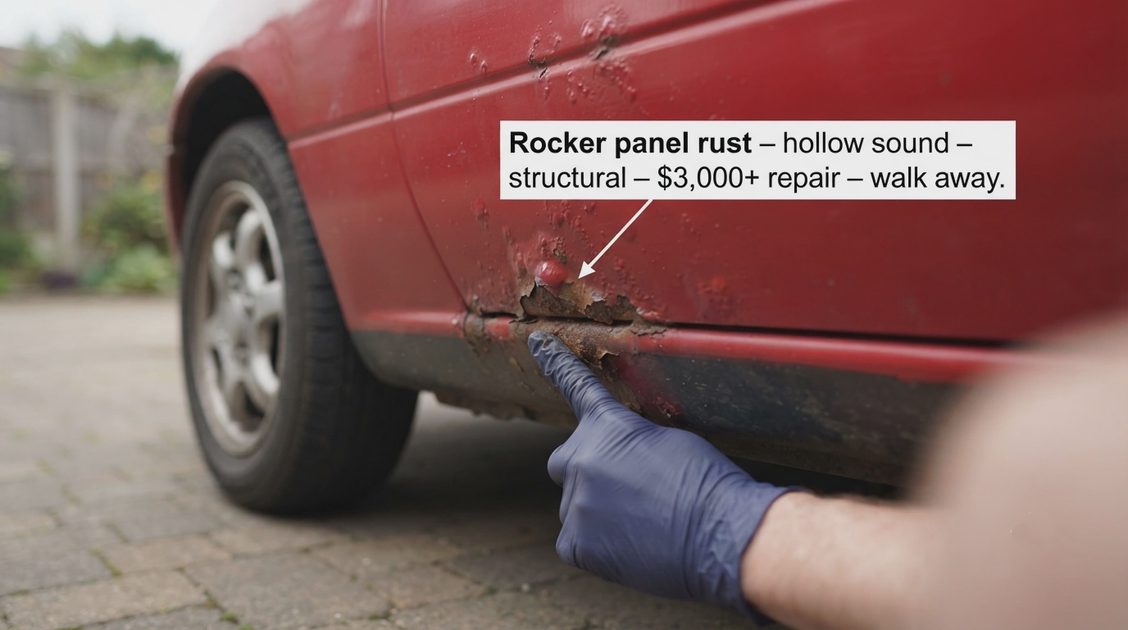
A2: Rear Quarter Panels / Rocker Panels (The Classic Miata Killer)
Where to look: Just in front of the rear wheels, where the rocker panel meets the rear quarter. Also behind the rear wheels, at the bottom of the quarter panel.
What to do:
Run your hand along the bottom of the rocker panel, just ahead of the rear wheel.
Look for bubbles in the paint, or rust coming through.
Tap the area with your knuckle — if it sounds hollow, rust is underneath.
Open the door and look at the rocker panel from inside the door jamb. Rust often starts here and works its way out.
Why it matters: The rocker panels on the NA are structural. They're part of the car's unibody. Rust here means the car's structure is compromised. This is the #1 killer of NAs.
Red flag: Any visible rust holes in the rocker panel. Any bubbling paint in the lower 6 inches of the rear quarter panel. Hollow-sounding metal when tapped.
If you see this: Walk away. It's a $3,000+ repair to do it right.
A3: Floor Pans (Especially Driver's Side)
Where to look: Under the car, directly under the seats. The floor pans are prone to rusting, especially where the drain plugs are.
What to do:
Get under the car.
Remove the drain plugs (if they're still there) and look inside.
Poke the floor pan with a screwdriver — especially around the edges.
Why it matters: Rusted floor pans can mean your seat mounts are compromised. In a crash, the seat could tear through the floor.
Red flag: Holes in the floor pan. Soft spots. Rust spreading from the drain plug area.
A4: A-Pillar / Cowl Rust
Where to look: At the base of the windshield, where the A-pillar meets the cowl (the plastic panel below the windshield).
What to do:
Remove the plastic cowl panel (it's held on by clips).
Look for rust where the A-pillar meets the body.
Check the corners of the windshield frame.
Why it matters: Rust here can compromise the windshield seal and allow water into the cabin. In severe cases, it affects the car's structural rigidity.
Red flag: Visible rust holes at the base of the A-pillar. Rust penetrating through the windshield frame.
A5: Differential Mounts / Subframe Rust
Where to look: Under the rear of the car, where the differential is mounted to the subframe.
What to do:
Look at the subframe and the differential mount brackets.
Check for rust on the subframe itself.
Why it matters: The differential mounts and subframe hold the rear suspension and drivetrain. If they rust through, the rear end can fall out.
Red flag: Rust holes in the subframe. Rusted-through differential mounts.
Section B — Major Concerns (Negotiate Hard)
These issues are repairable, but they're expensive. Use them to negotiate the price down.
B1: Front Frame Rails (Mild Surface Rust)
What to look for: Surface rust on the frame rails — no holes, no soft spots. Just flaking paint and a bit of orange.
What to do: Same as A1, but look for the severity. If it's surface rust only, it's repairable (wire brush, rust converter, paint).
How it affects price: $500–$1,000 off — the cost of treatment and prevention.
B2: Rocker Panels (Surface Rust Only)
What to look for: Surface rust on the outside of the rocker panel — no bubbles, no holes. The metal still feels solid.
What to do: Tap the rocker panel with your knuckle. If it's solid, it's surface rust. If it's hollow, it's a deal breaker.
How it affects price: $500 off — the cost of sanding, priming, and painting.
B3: Engine Bay Rust (Around the Brake Booster)
Where to look: Under the hood, on the firewall just above the pedals, where the brake booster and clutch master cylinder are mounted.
What to do: Look for rust around the mounting points. This is a common spot for rust because the brake fluid reservoir can leak.
Why it matters: Rust here can compromise the firewall and affect pedal feel.
How it affects price: $300–$500 off — the cost of patching and sealing.
B4: Differential Oil Leak
What to look for: Oil dripping from the rear of the differential, or oil residue on the differential housing.
What to do: Get under the car and look at the differential. If it's wet with oil, it's leaking.
Common leaks: Pinion seal, axle seals, or the differential cover gasket.
How it affects price: $300–$500 off — the cost of seals and labor.
B5: Transmission Leak
What to look for: Oil dripping from the transmission, or oil residue on the transmission housing.
Common leaks: Input shaft seal, output shaft seal, or the shift lever seal.
How it affects price: $300–$500 off — the cost of seals and labor.
Section C — Mechanical Flags (Check Each)
C1: Short-Nose Crankshaft Issue (1990–1991, Early 1992)
What to look for: Wobble in the crankshaft pulley when the engine is running. The pulley should spin true. If it wobbles, the crank keyway is failing.
Why it matters: The early 1.6L engines have a short nose on the crankshaft. The keyway wears out, which causes the timing belt pulley to wobble and eventually the crankshaft can break.
What to do:
Start the engine and look at the crankshaft pulley while it's idling.
If it wobbles, the repair is time-consuming and requires a special kit (Loctite fix) or replacement of the crankshaft.
Which cars are affected: VIN up to 209447 (1990–1991) and some early 1992 models.
Red flag: Wobbling pulley. If you see this, the engine will need significant work.
How it affects price: $1,000+ off — the cost of the repair.
C2: Engine Oil Leaks
What to look for: Oil dripping from the engine, or oil residue on the engine block.
Common leaks:
Valve cover gasket (most common — easy fix)
Camshaft seals
Front main seal (behind the timing belt)
Rear main seal (between the engine and transmission)
CAS (Cam Angle Sensor) O-ring — sits at the back of the intake cam and leaks onto the heater hose
What to do: Look under the car for oil drips. Look at the valve cover — if it's wet with oil, the gasket needs replacing. Look at the back of the engine — if it's wet, the CAS O-ring is likely leaking.
How it affects price:
Valve cover gasket: $100–$200 (DIY)
CAS O-ring: $20 and 30 minutes (DIY)
Front main seal: $300–$500 (requires timing belt removal)
Rear main seal: $500–$800 (requires transmission removal)
C3: Cooling System Issues
What to look for:
Rust in the coolant
Green or brown sludge in the coolant
Leaks from the radiator, hoses, or water pump
Overheating on test drive
What to do:
Remove the radiator cap (when cold) and look at the coolant.
Look for rust or sludge.
Inspect the radiator for green or brown stains (indicating leaks).
Squeeze the upper radiator hose — it should be firm when the engine is warm, not soft.
On the test drive, watch the temperature gauge — it should stay in the middle.
Common issues:
Radiator turns brown/green — the plastic end tanks are failing. Replace it.
Water pump leaking — listen for a whining noise or look for a leak at the front of the engine.
Heater hoses at the back of the engine — these are in a tight spot and prone to failure. If they're original, replace them.
How it affects price:
Radiator: $100–$200 (DIY)
Water pump: $300–$500 (requires timing belt)
Heater hoses: $100–$200 (DIY, but tight access)
C4: Timing Belt Service
What to look for: Records of timing belt replacement. If there are no records, it's overdue.
What to do: Check the service records. The timing belt should be replaced every 60,000 miles (or 100,000 miles on later models) or 5 years.
Why it matters: The NA's 1.6L and 1.8L engines are interference. If the timing belt breaks, the pistons hit the valves. Engine rebuild is $2,000+.
How it affects price: $500–$800 off — the cost of the timing belt service (belt, tensioner, idler, water pump).
C5: Clutch Condition
What to look for: Slipping clutch, hard engagement, or high engagement point.
What to do:
On the test drive, accelerate at full throttle in a higher gear at low RPM — if the clutch slips (the engine revs up without acceleration), it's worn out.
The clutch pedal should engage in the middle of the pedal travel. If it engages very high or very low, the clutch is worn.
How it affects price: $500–$800 off — the cost of a clutch replacement.
C6: Shifter Feel (The "Sloppy Shifter")
What to look for: The shifter feels loose, or it's hard to find gears.
What to do: The NA's shifter has a plastic bushing that wears out. It's a common issue and an easy fix.
How it affects price: $50–$100 off — the cost of the bushing kit. (It's a cheap and easy DIY fix, so don't let the seller use it as a major issue.)
C7: Brake Condition
What to look for:
Brake pedal feel — should be firm, not spongy.
Squealing or grinding when braking.
Pulsation in the brake pedal — indicates warped rotors.
What to do:
Press the brake pedal firmly with the engine off. It should feel firm and not sink to the floor.
Look at the brake rotors — if they have deep scoring, they need replacement.
Check the brake fluid — it should be clear or amber, not black.
How it affects price:
Rotors and pads: $200–$400 (DIY)
Caliper rebuild: $100–$200 each
C8: Suspension Condition
What to look for:
Bouncing or wallowing over bumps — shocks are worn.
Creaking or clunking when turning — ball joints or tie rods are worn.
Uneven tire wear — alignment is off or suspension components are worn.
What to do:
Push down on each corner of the car. It should bounce once and stop. If it bounces multiple times, the shocks are worn.
On the test drive, listen for clunks or creaks over bumps.
Look at the tires — uneven wear indicates a suspension or alignment issue.
How it affects price:
Shocks: $300–$600 (DIY or shop)
Ball joints: $200–$400
Alignment: $100
Section D — Interior & Electrics (Check Each)
D1: Dashboard Cracks
The NA's dashboard is prone to cracking, especially on the passenger side. It's cosmetic — but replacement is expensive.
How it affects price: $200–$500 off if cracked.
D2: Seat Condition
The NA's seats have bolsters that wear out. Check for tears, wear, and broken seat rails.
How it affects price: $100–$500 off depending on condition.
D3: A/C and Heater Operation
What to do:
Turn on the A/C (if equipped) — it should blow cold air. If it doesn't, the system needs servicing.
Turn on the heater — it should blow hot air. If it doesn't, the heater core may be clogged or the blend door is stuck.
How it affects price:
A/C recharge: $100–$200
A/C repair (compressor/evaporator): $500–$1,000
Heater core replacement: $500–$800 (dash removal required)
D4: Headlight Operation (Pop-Up Lights)
The NA's pop-up headlights are iconic — and they often fail.
What to do:
Turn on the headlights. They should pop up smoothly and evenly.
Turn them off. They should retract smoothly.
If one moves slower than the other, the motor or linkage is worn.
How it affects price: $100–$200 per side — or upgrade to manual headlight linkages if the motor fails.
D5: Power Windows (If Equipped)
NA power windows are slow and often fail.
What to do: Roll the windows down and up. They should move — but they'll be slow. If they don't move at all, the motor or regulator is broken.
How it affects price: $100–$200 per side.
D6: Gauge Operation
What to do: Check all gauges — tachometer, speedometer, coolant temp, oil pressure (if equipped).
Common issues: The NA's oil pressure gauge uses a sender that fails. The gauge might not work — or it might read erratically.
How it affects price: $50–$100 for a new sender.
D7: Power Antenna (If Equipped)
The NA's power antenna often fails and stops retracting.
How it affects price: $100–$200 for a replacement.
Section E — Exterior (Check Each)
E1: Paint Condition
The NA's single-stage paint is thin and prone to fading, especially on red cars (which fade to pink).
What to do: Look for fading, clear coat failure, and scratches. If the paint is bad, budget for a respray.
How it affects price: $500–$2,000 off — depending on severity.
E2: Soft Top Condition
What to look for:
Tears or holes in the soft top.
Cloudy or cracked plastic rear window.
Leaks when you run water over it.
What to do: Inspect the top carefully. Look for wear points (the folds where it creases when down). Check the stitching.
How it affects price:
New soft top: $300–$500 (DIY) or $600–$1,000 (installed)
New plastic window: $100–$200
E3: Trunk Condition
What to look for: Rust in the trunk — especially where the spare tire sits. This indicates a leak from the rear window or trunk seal.
How it affects price: $200–$500 off.
E4: Glass Condition
What to look for: Cracks or chips in the windshield. The NA's windshield is easy to crack — and replacements are $200–$400.
How it affects price: $200–$400 off.
E5: Light Lenses Condition
What to look for: Cloudy headlight lenses (they're glass on the NA, so they don't cloud). Check for cracks in the taillights.
How it affects price: $100–$200 for replacement lenses.
Section F — The Test Drive (What to Feel For)
F1: Engine Performance
What to feel for:
Smooth idle (no hunting, no stuttering).
Good power throughout the rev range (it's not fast, but it should pull cleanly).
No hesitation, stumbling, or bucking.
F2: Transmission Feel
What to feel for:
The shifter should be precise and not vague.
No grinding in any gear (especially 2nd and 3rd).
The synchros should be smooth — if you feel a crunch when shifting quickly, the synchros are worn.
F3: Differential Noise
What to feel for: Whining from the rear at speed. The NA's differential can develop wear and whine.
How it affects price: $300–$600 for a used differential.
F4: Wheel Bearings
What to feel for: Grumbling from the wheels when cornering. A wheel bearing that's worn will make noise.
How it affects price: $200–$400 per side.
F5: Brake Pull
What to feel for: The car pulling to one side when braking. This indicates a sticking caliper or uneven pad wear.
F6: Alignment
What to feel for: The car pulling to one side while driving straight. This indicates an alignment issue.
Section G — Service History (What to Ask For)
Item | What to Ask |
|---|---|
Timing belt | When was it last replaced? (Should be every 60,000 miles) |
Water pump | Was it replaced with the timing belt? (It should be.) |
Clutch | When was it last replaced? |
Radiator | Has it been replaced? (Original ones turn brown/green and fail) |
Brake fluid | When was it last flushed? (Should be every 2 years) |
Transmission fluid | When was it last changed? |
Differential fluid | When was it last changed? |
Coolant | When was it last flushed? |
Shifter bushings | Have they been replaced? |
CAS O-ring | Has it been replaced? |
Quick Reference — Price Negotiation Guide
Issue | Cost to Fix | Negotiate Off |
|---|---|---|
Frame rail rust (surface) | $500–$1,000 | $500–$1,000 |
Frame rail rust (holes) | $2,000+ | Walk away |
Rocker panel rust (holes) | $3,000+ | Walk away |
Front subframe rust | $1,000+ | $1,000+ |
Timing belt overdue | $500–$800 | $500–$800 |
Rear main seal leak | $500–$800 | $500–$800 |
Radiator failing | $200 | $200 |
Clutch worn | $500–$800 | $500–$800 |
Short-nose crank wobble | $1,000+ | $1,000+ |
Soft top worn | $300–$500 | $300–$500 |
A/C not working | $100–$1,000 | $100–$1,000 |
Suspension worn | $300–$600 | $300–$600 |
Leaking differential | $300–$500 | $300–$500 |
Leaking transmission | $300–$500 | $300–$500 |
The Ideal NA Purchase
The ideal car has:
Condition | What to Look For |
|---|---|
No structural rust | Frame rails and rocker panels are solid |
Good service records | Timing belt, water pump, and clutch are documented |
Original or well-maintained paint | Not perfect — but not a disaster |
Working A/C and heater | Because it's nice to be comfortable |
Good compression | All cylinders within 10% of each other |
No major leaks | Valve cover gasket, CAS O-ring, and rear main seal are dry |
The budget: A good NA Miata costs between $5,000 and $10,000 depending on condition and mileage. If you find one for $3,000, there's a reason — you're inheriting a project. If you find one for $15,000, it's a collector car — and you're paying for that.
Don't buy the first one you see. Look at three or four. You'll learn to spot the red flags, and you'll know the right one when you find it.
Contributors
Role | Username | Notes |
|---|---|---|
Primary Author | @garage_chronicler | Based on inspecting 25+ NA Miatas over 5 years |
Technical Reviewer | @miata_shop_owner | Verified common rust areas and mechanical issues from shop experience |
Safety Review | @senior_editor_01 | Safety Critical flag approved — structural rust compromises crash safety |


No comments yet — grab the first one.