Let me say this as clearly as I can:
Torque-to-yield bolts are single-use fasteners. Full stop. No exceptions. Anyone who tells you otherwise is either misinformed, lazy, or willing to gamble with your engine.
I know what you're thinking. "But I've reused them before and it was fine." "The factory manual doesn't always say to replace them." "My buddy at the shop reuses them all the time."
I've heard it all. I've even done it myself — once. And I learned my lesson the hard way.
This isn't about being a parts-store shill or a dealership apologist. This is about physics, metallurgy, and the difference between "it worked last time" and "it's the right way to do the job."
What Is a Torque-to-Yield Bolt, Anyway?
Before we get into why you shouldn't reuse them, let's be clear on what they are.
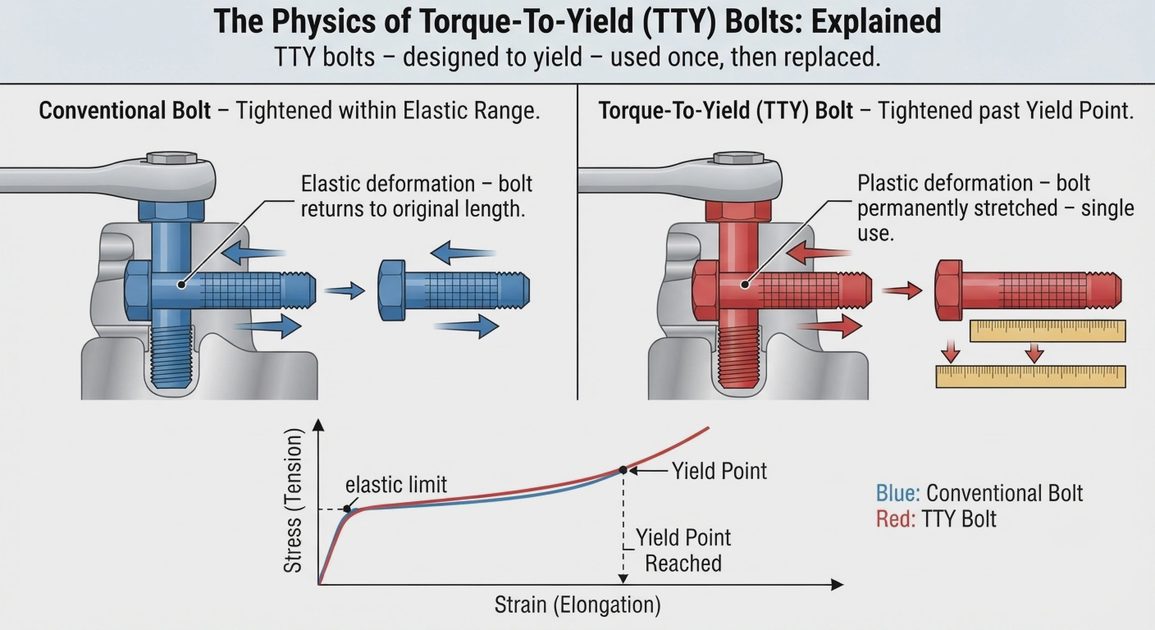
A torque-to-yield (TTY) bolt is designed to stretch when tightened. Unlike a conventional bolt that you torque to a specific value and it stays within its elastic limit (it returns to its original length when loosened), a TTY bolt is intentionally tightened past its elastic limit and into the plastic deformation zone.
Term | What It Means |
|---|---|
Elastic deformation | The bolt stretches but returns to its original length when loosened — like a rubber band that snaps back |
Plastic deformation | The bolt permanently stretches — it doesn't return to its original length |
Yield point | The point where the bolt transitions from elastic to plastic deformation |
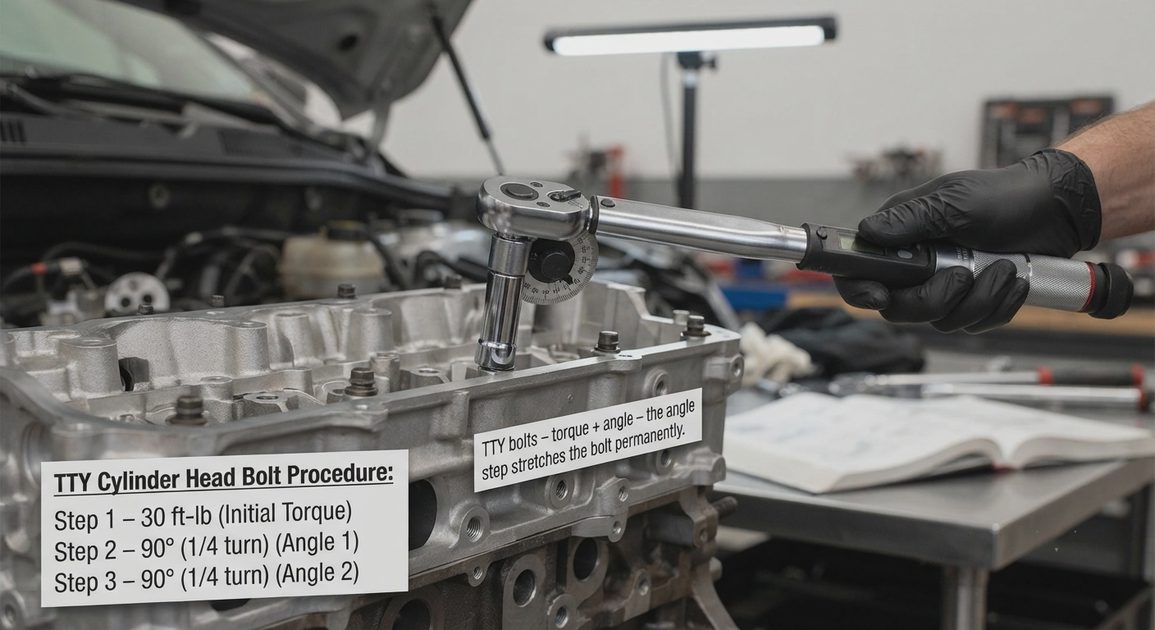
TTY bolts are designed to yield. They're tightened to a specific torque, then turned an additional angle (90°, 180°, etc.). That final angle is what stretches the bolt permanently.
The torque spec might be something like:
Step 1: 30 ft-lb
Step 2: 90° (1/4 turn)
Step 3: 90° (1/4 turn)
That second and third step is where the magic (and the problem) happens. The bolt is being stretched beyond its elastic limit, and it's never going back.
Why TTY Bolts Exist
Car manufacturers didn't invent TTY bolts to sell more parts. They exist for two reasons:
Reason | Why It Matters |
|---|---|
More consistent clamping force | Traditional torque-only methods have a wide variance in clamping force due to friction differences. Torque + angle is much more precise. |
Lighter components | Because you can achieve higher clamping force with a smaller bolt, you can use lighter cylinder heads and blocks. |
Better sealing | More consistent clamping means better head gasket sealing. |
The tradeoff: The bolt is destroyed in the process. It's engineered to be a one-time-use fastener.
Feature | Traditional Bolt | TTY Bolt |
|---|---|---|
Tightening method | Torque only | Torque + angle |
Stretches? | No (elastic) | Yes (plastic) |
Returns to original length? | Yes | No |
Clamping force consistency | Moderate | Excellent |
Can be reused? | Usually yes | No |
Cost | Cheap | More expensive |
The bolt is doing its job perfectly — once. Then it's done.
Why Reusing a TTY Bolt is a Bad Idea
Reason 1: It's Already Stretched
Once a TTY bolt has been tightened to its torque-and-angle spec, it has permanently deformed. The bolt is now longer than it was when it left the factory. The threads have been pulled. The shank has been stretched.
When you reuse it and try to torque it again, you're starting from a different baseline. The bolt is already at a different length. The clamping force you get — if you even reach the specified torque — is not the same as when it was new.
Attempt | What Happens |
|---|---|
First use (new bolt) | Bolt stretches to design spec. Clamping force is within tolerance. |
Second use (used bolt) | The bolt is already stretched. It can't generate the same clamping force at the same torque. It may not reach the required angle without breaking. |
What you feel | A used TTY bolt often feels "springy" or "soft" when you torque it. That's the sound of insufficient clamping force. |
Reason 2: Inconsistent Clamping Force
The entire point of a TTY bolt is consistent clamping force. When you reuse one, you lose that consistency.
You might not reach the required clamping force at all.
Different bolts on the same head might stretch differently — some more, some less.
Uneven clamping means uneven head gasket sealing. That's how you get coolant leaks, combustion gas leaks, and blown head gaskets.
Scenario | Clamping Force | Result |
|---|---|---|
New TTY bolts (correctly installed) | Consistent across all bolts | Head gasket seals properly |
Reused TTY bolts | Inconsistent — some bolts stretched more than others | Uneven clamping, gasket failure risk |
Reason 3: The Angle Spec Becomes Meaningless
The torque-angle method is calibrated for a new bolt of known length and metallurgy. When you reuse a bolt, the angle spec is no longer accurate.
A used bolt has a different yield point because it's already been yielded. When you apply the specified angle, you're not stretching it from its original length — you're stretching it from its already-stretched length. The final clamping force is different.
Reason 4: Thread Damage
TTY bolts often have rolled threads, which are stronger than cut threads. But they're still subject to wear and deformation. When you reuse a TTY bolt, the threads are no longer in their original condition. You're introducing another variable into a system that was designed to be precise.
Reason 5: The Risk of Breaking
This is the worst-case scenario. A used TTY bolt that's been stretched once is more likely to break on the second installation. And when a bolt breaks in a cylinder head, you're looking at a repair that costs a lot more than a new set of bolts.
How a TTY bolt breaks when reused:
The bolt is already stretched and has micro-cracking from the first installation.
When you apply torque and angle again, you push it past its already-weakened yield point.
The bolt snaps — often while you're torquing it, sometimes later, under load.
The result: A broken bolt in the block. Now you're drilling, extracting, and hoping you don't damage the threads.
The "But I've Reused Them Before" Argument
I've heard this a dozen times. And here's my response: "It worked last time" is not a valid engineering principle.
Rebuttal | My Response |
|---|---|
"I reused head bolts on my Civic and it was fine." | You got lucky. The engine didn't blow up — yet. But you reduced the margin of safety. |
"The factory manual doesn't say to replace them." | Some older manuals don't. Newer ones do. Engineers learned from failures. |
"ARP says their bolts are reusable." | ARP bolts are not TTY. They're designed for multiple uses with a different torque method. |
"I've seen shops reuse them all the time." | Shops aren't always right. Some take shortcuts. That doesn't make them safe. |
"It's just a small bolt — it'll be fine." | Small bolts fail too. And when they do, they cost big money. |
Here's the thing: When you reuse a TTY bolt, you're betting your engine on a bolt that's already been stretched, stressed, and weakened. The odds might be in your favor. But when you lose that bet, you lose big.
What About Aftermarket Bolts (ARP, etc.)?
Aftermarket bolts like ARP are a different situation entirely. They're designed to be reused.
Brand | Type | Reusable? |
|---|---|---|
OEM TTY | Torque + angle, yields during installation | No |
ARP (most) | Torque only (with lube), does not yield | Yes |
Other aftermarket (non-TTY) | Torque only, standard bolt design | Usually yes |
The key difference: ARP and similar bolts are not TTY. They're designed to stay within their elastic limit. They generate clamping force through the torque applied to the fastener, not through permanent stretching. They can be reused — and with ARP's torque spec and lube, you get consistent results.
But — even ARP bolts should be inspected before reuse. Check for thread damage, corrosion, or signs of over-tightening. If they look questionable, replace them.
When Can You Reuse a TTY Bolt?
The correct answer is never. But if you're in a bind and you absolutely must, here are the conditions:
Don't do it on head bolts. This is the worst place to compromise. Head gasket failure costs more than a set of bolts.
Don't do it on main bearing bolts. Same reason — catastrophic failure is too expensive.
Maybe — maybe — on non-critical fasteners. Things like timing belt tensioner bolts or accessory brackets. But even then, consider whether saving $10 is worth the risk.
My recommendation: Just replace them. They're not that expensive. A set of OEM head bolts for most engines is $50–$150. A set of main bearing bolts is similar. That's the cost of a night out. It's not worth risking a $2,000+ repair.
The Cost Argument
Item | Cost | What's the Alternative? |
|---|---|---|
Set of head bolts | $50–$150 | Buy a new set |
Reusing used bolts | $0 | But if they fail... |
Head gasket replacement | $500–$1,000 (DIY) | Engine tear-down |
Engine rebuild | $2,000–$5,000 | If a bolt breaks and damages the engine |
New engine | $5,000–$10,000+ | If the block is damaged |
Spending $100 on bolts is cheap insurance against a $5,000 failure.
What About "Re-Torquing"?
Some older engines require you to retorque the head bolts after a certain number of miles. This is a different procedure — you're checking the torque on a bolt that was already tightened once, but the bolt itself was never yielded.
Modern TTY bolts don't require retorquing. They're designed to be tightened once, to a specific procedure, and left alone. If you're following the torque-angle spec, the bolt has already done its job. Retorquing would just stretch it further — which you don't want.
How to Identify TTY Bolts
Indicator | What to Look For |
|---|---|
Torque procedure | If the spec includes "torque + angle," it's TTY |
Bolt marking | Sometimes marked with a "T" or "TTY" on the head |
Thread design | Often have rolled threads (smooth, shiny appearance) |
Part number | Check the service manual or parts catalog |
Service manual | Will explicitly state "replace with new bolts" |
When in doubt, replace them. If you don't know whether a bolt is TTY or not, the safest move is to buy new ones.
The Exception That Proves the Rule
There's one situation where TTY bolts can sometimes be reused: on engines where the service manual explicitly allows it. Some older engines (like the 4G63 in the Mitsubishi Evolution) used TTY bolts that could be reused once — but even then, it's debated.
If you're working on a classic engine with a specific procedure that allows reuse, follow the service manual. But if you're working on anything made in the last 20 years? Replace them.
My Personal Experience
I reused a set of TTY head bolts exactly once. It was on a Subaru EJ25. I was doing a head gasket job, I was on a budget, and I thought "they're just bolts, they'll be fine."
I torqued them to spec. I did the angle turns. Everything felt fine.
Three months later, the head gasket blew again. The bolts had stretched unevenly. Two of them had bottomed out and weren't applying enough clamping force. I got to do the job twice.
The second time, I bought new bolts. And the car ran for another 80,000 miles before I sold it.
I learned the hard way. You don't have to.
Conclusion
Argument | Verdict |
|---|---|
"TTY bolts are single-use" | Yes. Full stop. |
"Can they be reused?" | Not safely. |
"Has anyone gotten away with reusing them?" | Yes — but they got lucky. |
"Is it worth the risk?" | No. A set of bolts costs less than a tow truck. |
"What's the correct answer?" | Replace them. Every time. No exceptions. |
Torque-to-yield bolts are engineered to be used once. They stretch. They deform. They don't go back to their original shape. When you reuse them, you're relying on a bolt that's already done its job — and hoping it can do it again.
Don't gamble with your engine. Replace the bolts.
Contributors
Role | Username | Notes |
|---|---|---|
Primary Author | @torquemaster | Based on 15 years of engine work and one expensive lesson |
Technical Reviewer | @engine_builder | Verified TTY bolt physics and service manual references |
Safety Review | @senior_editor_01 | Safety Critical flag approved — bolt failure can cause catastrophic engine damage |





No comments yet — grab the first one.