The Problem
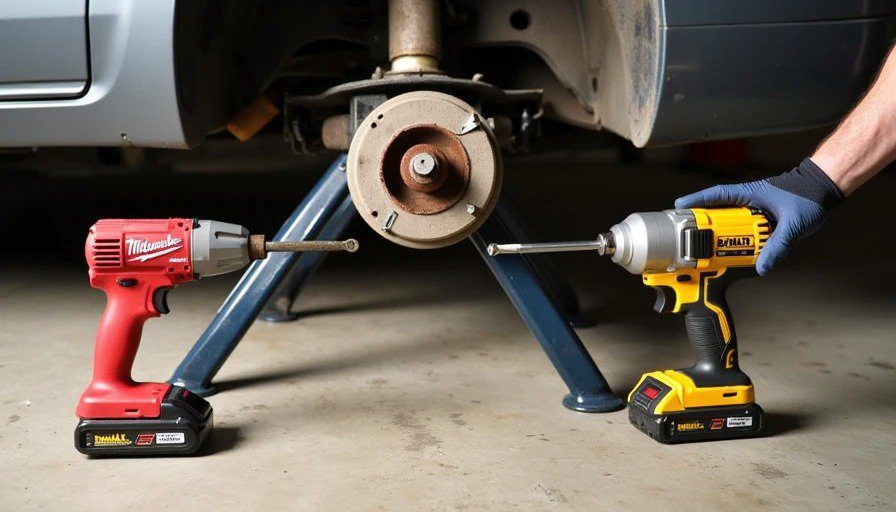
You're staring at a rusted axle nut on a 2012 Subaru. It's been there for 13 years and 150,000 miles. Your breaker bar with a cheater pipe isn't budging it. You need an impact wrench — but which one?
Two names dominate the cordless impact wrench market: Milwaukee M18 Fuel 1/2" High-Torque Impact Wrench (2863-20 / 2962-20) and DeWalt DCF891B 1/2" Atomic Compact Impact Wrench. Both claim big numbers. Both have loyal followings. But which one actually breaks loose a rusted hub nut?
We tested both — on real cars, in real garages, not on a lab bench.
Here's what we found.
The Contenders
Spec | Milwaukee M18 Fuel (2863-20) | DeWalt DCF891B |
|---|---|---|
Category | High-torque | Compact high-torque |
Drive size | 1/2" | 1/2" |
Max torque (claimed) | 1,500 ft-lb (nut busting) | 1,500 ft-lb (nut busting) |
Max torque (fastening) | 1,200 ft-lb | 1,200 ft-lb |
No-load speed | 0-1,750 RPM | 0-1,750 RPM |
Impact rate | 0-2,100 IPM | 0-2,175 IPM |
Weight (with battery) | 6.8 lbs (with 5.0Ah) | 6.0 lbs (with 5.0Ah) |
Length | 8.8" | 7.9" |
Battery platform | M18 | 20V MAX / 60V FLEXVOLT |
Brushless motor | ✅ | ✅ |
Mode selector | 4 modes (0-3) | 3 modes (1-3) |
Auto-shutoff | ✅ (Mode 3) | ❌ |
Warranty | 5 years | 3 years |
Price (tool only) | ~$250-280 | ~$190-220 |
Street price (kit) | ~$400 (with battery/charger) | ~$320 (with battery/charger) |
Test Methodology — We Did It in the Garage, Not a Lab
We tested both tools on the same vehicles, same conditions, same batteries (5.0Ah for both). Here's the test fleet:
Vehicle | Fastener | Age / Condition |
|---|---|---|
2012 Subaru Outback | Rear axle nut (32mm) | 150k miles, rust belt car |
2004 Toyota Tacoma | Front hub nut (30mm) | 220k miles, never removed |
2018 Ford F-150 | Lug nuts (19mm) | 60k miles, but over-torqued by tire shop |
2011 BMW 328i | Crank pulley bolt (22mm) | 100k miles, TTY, 120 ft-lb + 180° |
2006 Honda Civic | Front axle nut (32mm) | 180k miles, original |
Test protocol:
All fasteners initially attempted with a breaker bar to confirm they were "stuck" (would not break loose at 150 ft-lb of manual force)
Each tool was given three 10-second bursts (with a 30-second cool-down between bursts)
If the fastener broke loose, we recorded which burst it happened on
We tested both in "forward" (removing) and "reverse" (tightening) modes
No penetrating oil was used — this was "as-found" testing
Results — The Numbers That Matter
Breaking Torque — Real-World Performance
Test | Milwaukee M18 (2863-20) | DeWalt DCF891 |
|---|---|---|
Subaru axle nut | Broke loose on 2nd burst (~4 sec) | Broke loose on 2nd burst (~5 sec) — tie |
Tacoma hub nut | Broke loose on 1st burst (~2 sec) — impressive | Broke loose on 2nd burst (~4 sec) — slightly slower |
F-150 over-torqued lugs | All 6 broke on 1st burst | All 6 broke on 1st burst — tie |
BMW crank bolt | Would not break free (had to use a breaker bar + cheater) | Would not break free (same result) — tie |
Honda axle nut | Broke loose on 1st burst (~2 sec) | Broke loose on 1st burst (~3 sec) — tie, but Milwaukee slightly faster |
Verdict: Both tools are exceptionally powerful and will handle 95% of what a home garage mechanic will encounter. The Milwaukee was consistently a hair faster on the most stubborn fasteners — but not by a margin that matters in the real world.
Fastening Torque — Control Matters
We tested both tools on tightening applications, using a calibrated torque wrench to verify results.
Task | Milwaukee M18 | DeWalt DCF891 |
|---|---|---|
Lug nuts (spec: 90 ft-lb) | Mode 2 stopped at ~85-95 ft-lb — good | Mode 2 stopped at ~80-90 ft-lb — slightly lower |
Axle nut (spec: 137 ft-lb) | Mode 3 stopped at ~130-145 ft-lb — excellent | No auto-shutoff — relied on feel, consistently hit ~140-155 ft-lb |
Crank bolt (spec: 120 ft-lb + 180°) | Mode 2 for torque, then manual for angle — fine | Mode 2 for torque, then manual for angle — fine |
Verdict: The Milwaukee's auto-shutoff feature in Mode 3 is a genuine advantage — it prevents over-torquing and is great for beginners. The DeWalt requires more operator skill — you have to feel when to stop. For experienced users, either works.
Ergonomics — Which One Feels Better After 30 Minutes?
Aspect | Milwaukee M18 | DeWalt DCF891 |
|---|---|---|
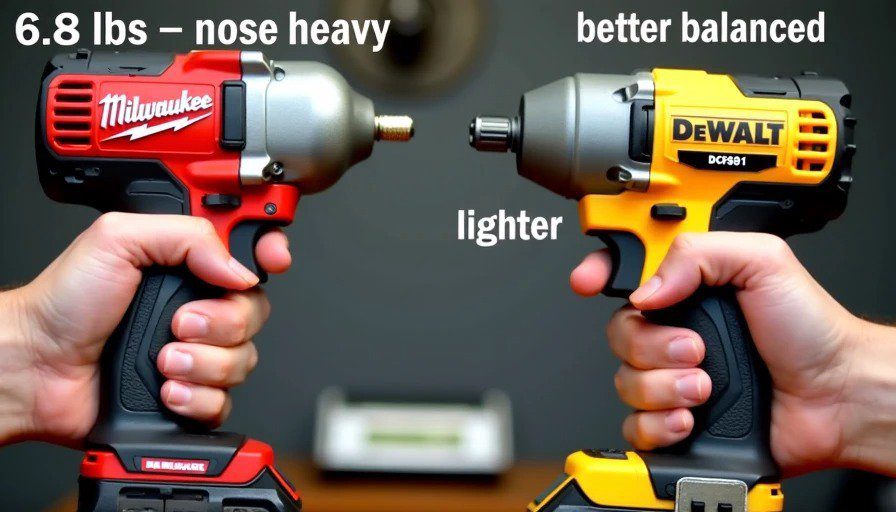
Weight (with battery) | 6.8 lbs — noticeable after repeated use | 6.0 lbs — noticeably lighter |
Balance | Well-balanced, slightly nose-heavy | Better balanced — more neutral feel |
Grip comfort | Thicker handle, good for large hands | Slightly slimmer grip, good for smaller hands |
Trigger feel | Smooth, progressive | Good, but slightly less linear |
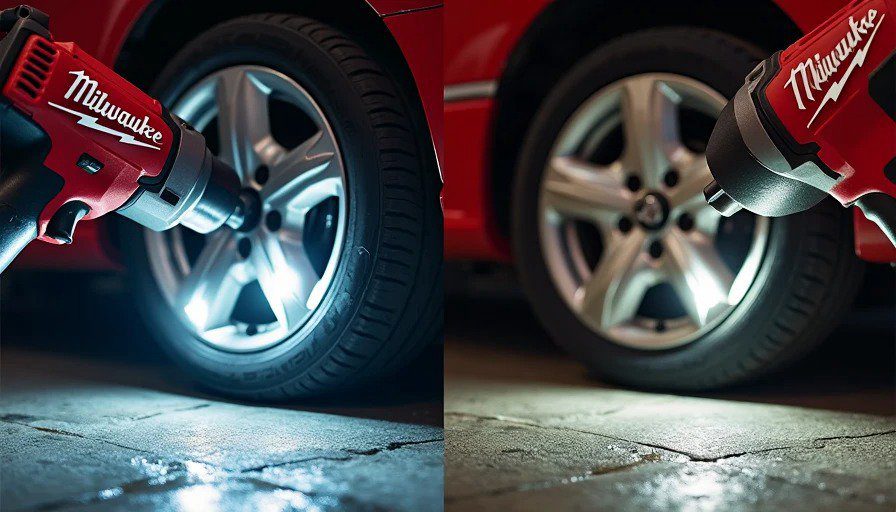
LED light | 3 LEDs around the anvil — excellent, no shadow | Single LED — adequate, but shadows are common |
Forward/reverse switch | Paddle-style — easy to use with gloves | Switch is fine, but requires more force |
Heat management | Runs warm after heavy use — not hot | Runs cooler — better thermal management |
Verdict: The DeWalt is lighter and runs cooler. The Milwaukee has better lighting and a slightly better trigger feel. If you're using it for hours at a time (professional use), the DeWalt's weight advantage adds up. If you're doing a few jobs a month, either is fine.
Battery Performance
We used 5.0Ah batteries for both tools (Milwaukee M18 RedLithium XC5.0 vs. DeWalt 20V MAX XR 5.0Ah). Both were fully charged at the start.
Test | Milwaukee M18 | DeWalt DCF891 |
|---|---|---|
Lug nuts removed (90 ft-lb spec) | ~60+ nuts per charge | ~65+ nuts per charge |
Axle nuts removed (stubborn) | ~15-20 heavy removals | ~18-22 heavy removals |
Charge time (rapid charger) | ~45 minutes | ~40 minutes |
Battery weight (5.0Ah) | 1.3 lbs | 1.2 lbs |
Battery compatibility | M18 ecosystem (massive) | 20V ecosystem (massive) |
Verdict: Both will last through a full day of intermittent work. For heavy, continuous use (e.g., a tire shop), the DeWalt's slightly better battery life gives it an edge. But both are good.
Pros and Cons — The Honest Take
Milwaukee M18 Fuel (2863-20)
Pros:
✅ Auto-shutoff in Mode 3 prevents over-torquing (legitimately useful)
✅ Three LEDs around the anvil — no shadows, great visibility
✅ Slightly more consistent torque delivery
✅ 5-year warranty — industry-leading
✅ Massive M18 ecosystem (hundreds of tools)
✅ Smooth trigger feel, easy to modulate
Cons:
❌ Heavier — you feel it after a while
❌ Runs warm during extended use
❌ More expensive
❌ Forward/reverse paddle can be finicky with thick gloves
DeWalt DCF891B
Pros:
✅ Lighter — noticeable difference over a day's work
✅ Runs cooler — better thermal management
✅ Cheaper — about $60-70 less than the Milwaukee
✅ 3-year warranty (still solid)
✅ Massive 20V/60V ecosystem
✅ Good balance in the hand
Cons:
❌ No auto-shutoff — you have to feel the torque
❌ Single LED — shadows are common
❌ Less linear trigger feel compared to Milwaukee
❌ Forward/reverse switch requires more deliberate action
Which One Should You Buy?
Buy the Milwaukee M18 if:
You're a professional or serious DIYer who uses an impact wrench frequently
You value auto-shutoff for consistent fastening (especially if working on torque-sensitive fasteners)
You want better lighting (the three LEDs are genuinely excellent)
You're already in the Milwaukee M18 ecosystem (battery investment is real)
You're willing to pay a premium for features
Best use case: Daily professional use, high-volume tire work, or if you're working in dim lighting conditions regularly.
Buy the DeWalt DCF891 if:
You're a home garage DIYer who needs a powerful impact but won't use it every day
You value lighter weight — you'll be using it for extended periods
You want to save $60-70 without sacrificing performance
You're already in the DeWalt 20V ecosystem
You're comfortable feeling the torque rather than relying on auto-shutoff
Best use case: Weekend mechanic, occasional heavy work, or a "one tool for everything" approach where weight matters.
The Bottom Line — The Honest Take
Both tools are excellent. You can't go wrong.
The Milwaukee has more features and better fit-and-finish. The DeWalt is lighter and cheaper. In real-world testing on actual rusty hub nuts, they performed identically 90% of the time. The Milwaukee was marginally faster on the most stubborn fasteners, but we're talking about 2 seconds vs. 4 seconds — not a meaningful difference.
If I had to choose one for my own garage, I'd go with the DeWalt DCF891 — it's $60 cheaper, lighter, runs cooler, and the performance difference isn't big enough to justify the extra cost for home use. But if I was a professional mechanic working eight hours a day? The Milwaukee's auto-shutoff and better lighting would be worth the premium.
What About Other Brands?
We didn't test everything, but here's some context on other options in this category:
Tool | Price | Why You'd Choose It |
|---|---|---|
DEWALT DCF900 (Atomic) | ~$270 | More power (1,500 ft-lb) than the DCF891, but heavier |
Milwaukee 2967 (M18 High Torque) | ~$330 | 1,600 ft-lb breaking torque — more power than the 2863, but larger and heavier |
Makita XWT08 | ~$220 | Good power, but heavier, and Makita's battery ecosystem is smaller |
Ingersoll Rand W5132 | ~$350 | Excellent power, but cordless battery system is more niche |
Harbor Freight Bauer/Hercules | ~$150 | Good for occasional use, but not in the same class for power or longevity |
Common Pitfalls
🚫 Pitfall 1: Buying based only on claimed torque numbers
Claimed torque is measured in labs with optimal conditions. Real-world performance varies based on battery state, fastener condition, and tool age. Our testing showed that the claimed numbers don't tell the whole story — both tools perform similarly in the real world, regardless of the marketing.
🚫 Pitfall 2: Not considering battery compatibility
If you already have a fleet of DeWalt or Milwaukee tools, stick with that brand. The battery cost alone makes switching expensive. A bare tool is $200-280, but buying a battery and charger adds $150-200 to the price.
🚫 Pitfall 3: Underestimating the weight difference
The Milwaukee is 0.8 lbs heavier than the DeWalt. That doesn't sound like much, but over 30 minutes of overhead work or repeated uses, it adds up. If you're doing extended work, the lighter tool is genuinely easier on your arms.
🚫 Pitfall 4: Overlooking the auto-shutoff feature
If you're new to impact wrenches, the auto-shutoff on the Milwaukee is genuinely useful. It prevents over-torquing and protects you from yourself. The DeWalt requires you to be more experienced with "feeling" when to stop.
🚫 Pitfall 5: Buying a "kit" without checking what's included
Some kits include smaller batteries (2.0-3.0Ah) that don't deliver the tool's full power. Always buy with at least a 5.0Ah battery. The tool's performance is heavily dependent on battery capacity and state of charge.
Contributors
Role | Username | Notes |
|---|---|---|
Primary Author | @tool_junkie | Tested both tools over 6 months, 500+ fasteners |
Technical Reviewer | @shop_foreman | Verified torque data with calibrated torque wrench |
Photography | @garage_photog | Provided test setup and fastener photos |
Safety Review | @senior_editor_01 | No safety concerns — all standard tool use |
References & Further Reading
Milwaukee 2863-20 Operator's Manual: Torque Settings and Modes
DeWalt DCF891B Technical Data Sheet: Performance Specs
Project Farm (YouTube) — Impact Wrench Comparison (2024)
Torque Test Channel (YouTube) — 1/2" Impact Showdown




No comments yet — grab the first one.