
The Problem
TorquePedia is built on the idea that knowledge should be open, editable, and improved by the community. That's our strength. But it also creates a risk that we need to address head-on.
Some repairs, if done incorrectly, don't just waste time or money — they kill people.
Brake failures. Suspension collapses. Steering linkage separation. Wheel detachment.
These aren't theoretical risks. They happen. They happen when someone follows a poorly written guide, when a torque spec is wrong, or when a critical step is omitted. And they happen because the person writing the guide didn't know what they didn't know.
Right now, TorquePedia treats a brake pad replacement the same way it treats an oil change. The same editorial standards. The same review process. The same trust-level permissions.
That's a problem.
The Proposal
Create a "Safety Critical" flag that applies to entries involving any system where failure could result in injury or death.
The flag would:
Feature | What It Does |
|---|---|
Visible badge | A prominent warning banner at the top of the entry, visible to every reader |
Elevated permissions | Only Level 2+ users can create or edit Safety Critical entries |
Mandatory verification | Entries must be reviewed and verified by at least two Level 3+ users |
Review timeline | Unverified Safety Critical entries must be reviewed within 30 days or be temporarily hidden |
Change notification | Any edit to a Safety Critical entry triggers a notification to all users who have contributed to that entry |
Which Systems Would Be Covered?
The flag would apply to entries that involve work on systems where failure creates a life-safety risk. This includes but is not limited to:
System | Examples |
|---|---|
Brakes | Pad replacement, rotor replacement, caliper rebuild, brake line replacement, master cylinder, ABS bleeding |
Suspension | Ball joint replacement, tie rod end replacement, control arm replacement, coilover installation, spring compression |
Steering | Steering rack replacement, power steering line repair, steering shaft coupling |
Wheels and tires | Wheel bearing replacement, hub replacement, axle nut torque |
Fuel system (high pressure) | Fuel line replacement, injector work (on high-pressure systems) |
Airbag / SRS | Any work involving airbag components or sensors |
Structural | Subframe repair, control arm mount repair, anything involving load-bearing chassis points |
Safety systems | Seat belt repair, collision avoidance system calibration |
The rule: If a component failure at highway speed could cause loss of control, loss of braking, or injury to the vehicle occupants, it's Safety Critical.
How the Flag Would Work
For New Entries
Step | Who | What Happens |
|---|---|---|
1 | Contributor | Submits entry, flags it as Safety Critical |
2 | System | Entry goes into a special review queue |
3 | Level 3+ Users | Two users must verify the entry for technical accuracy |
4 | System | Entry is published with the Safety Critical badge |
If the entry is not verified within 30 days, it is temporarily hidden until verification is complete.
For Existing Entries
Step | Who | What Happens |
|---|---|---|
1 | Any Level 2+ User | Proposes that an entry be flagged as Safety Critical |
2 | Level 3+ Users | Two users must agree with the proposal |
3 | System | Entry receives the Safety Critical badge |
4 | System | Any existing review/verification history is retained, but the entry's permissions are elevated going forward |
For Edits to Safety Critical Entries
Step | Who | What Happens |
|---|---|---|
1 | Editor | Proposes an edit to a Safety Critical entry |
2 | System | Notification goes to all previous contributors to that entry |
3 | Level 3+ Users | The edit is reviewed and approved by at least one Level 3+ user |
4 | System | Edit is published with a notation of who approved it |
Why We Need This
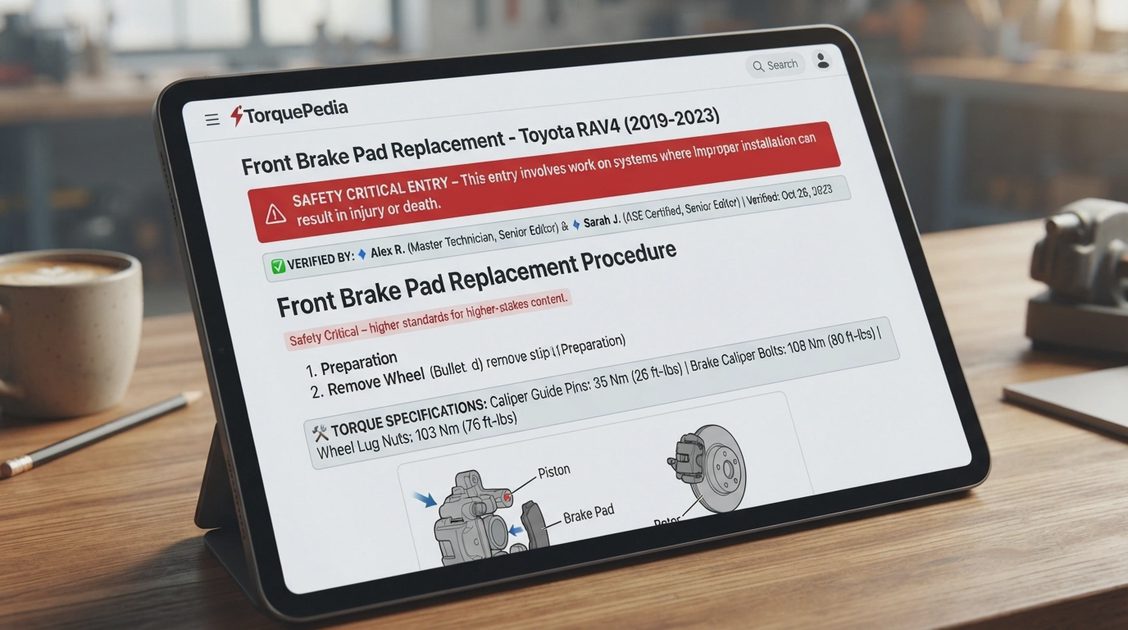
Reason 1: We Have a Responsibility
TorquePedia is a knowledge base. People will follow our instructions. If an instruction is wrong — if a brake pad is installed incorrectly, if a ball joint is torqued to the wrong spec, if a safety-critical component is omitted — someone could die.
We don't get to say "it's just a forum post." We're building something that people trust. That trust comes with responsibility.
Reason 2: Not All Knowledge Is Equal
An oil change guide that misses a step causes a mess. A brake job guide that misses a step causes a crash.
The editorial standards we apply to basic maintenance are not sufficient for life-safety systems. We need higher standards for higher-stakes work.
Reason 3: Contributors Need Clear Guidance
Right now, a contributor writing a brake pad guide might not know what they don't know. They might omit a torque spec, skip a warning about brake fluid contamination, or fail to mention the need to bleed the ABS system.
The Safety Critical flag tells contributors: "This entry needs extra care. This entry needs verification. This entry is different."
Reason 4: Readers Need Clear Warning
A reader searching for "how to replace brake pads" needs to know if they're looking at a guide that has been verified or one that hasn't.
The Safety Critical badge is a signal. It tells the reader: "This entry has been reviewed by experienced members of the community. The torque specs have been checked. The procedure has been vetted."
Potential Concerns — and Responses
Concern 1: "This slows down content creation"
Response: Yes, it will slow down Safety Critical entries. That's intentional. A brake job guide that takes an extra week to publish is better than a brake job guide that's published in an hour and is wrong. The delay is the cost of accuracy.
Concern 2: "What about entries that are Safety Critical but not clearly covered by the list?"
Response: The list is a starting point, not a complete catalog. Any user can propose that an entry be flagged as Safety Critical. The community decides. If it's a close call, we err on the side of caution.
Concern 3: "What about DIYers who just want a quick answer?"
Response: The Safety Critical badge doesn't stop anyone from reading. It just adds a warning and a verification check. The information is still accessible. The difference is that the reader knows the information has been vetted.
Concern 4: "Won't this discourage people from writing about safety-critical topics?"
Response: It might discourage some. But the people who care about accuracy — the people who actually know how to do a brake job correctly — will still write. And their entries will be more trusted because of the verification process. We're not asking people to be perfect. We're asking people to be careful.
Concern 5: "How do we prevent false flags?"
Response: Flagging an entry as Safety Critical requires agreement from two Level 3+ users. This prevents a single user from arbitrarily flagging an entry (or refusing to flag it). The system is balanced.
Concern 6: "What about entries that are Safety Critical but are written by a Level 3 user? Can they self-verify?"
Response: No. Self-verification is not allowed. The requirement is that two Level 3+ users verify the entry — and they cannot be the same person who wrote it. This ensures independent review.
What This Would Look Like to a Reader

A Safety Critical entry would have a prominent banner at the top:
⚠️ SAFETY CRITICAL ENTRY
This entry involves work on systems where improper installation can result in injury or death.
This entry has been verified by: @user1, @user2 (Level 3 Senior Editors)
Last verified: 2026-01-15
If you are unsure about any step in this procedure, consult a professional mechanic.
The banner would be visually distinct — red border, warning icon, and clearly visible at the top of the page.
What This Would Look Like to a Contributor
When submitting a new entry, the contributor would see a checkbox:
☑️ This entry involves safety-critical systems (brakes, suspension, steering, fuel system, airbags, or structural components)
If checked, the contributor would see:
Note: Safety Critical entries require verification by two Level 3 Senior Editors before publication. Your entry will be reviewed within 30 days.
Implementation Phases
Phase 1: Flag and Badge
Create the Safety Critical flag in the system
Add the visual badge to the entry template
Enable Level 2+ users to propose Safety Critical status for existing entries
Phase 2: Verification Workflow
Build the review queue for Safety Critical entries
Require two Level 3+ users for verification
Add the 30-day review timeline
Phase 3: Notification System
Notify contributors when their Safety Critical entry is edited
Notify Level 3+ users when a Safety Critical entry is pending review
Add a dashboard for Senior Editors to track pending verifications
Questions for the Community
Before we implement this, I want to hear from the community:
Question | Why It Matters |
|---|---|
Should the Safety Critical flag apply to all brake and suspension work, or only certain types? | Some jobs (pad replacement) are lower risk than others (caliper rebuild). We need to define boundaries. |
Should we require two verifications, or three? | More verification increases accuracy but slows publication. We need balance. |
Should entries that are Safety Critical be editable by Level 2+ users, or only Level 3+? | Tier 2 users can currently edit most entries. Raising the bar would increase accuracy but limit contributors. |
Should we have a category for "moderate risk" entries — not life-safety, but expensive to get wrong? | Some entries (engine timing, transmission reassembly) are not life-safety but can cause catastrophic engine failure. Do we want a separate flag for these? |
What should we do with existing entries that are Safety Critical but haven't been verified? | Do we grandfather them in? Do we require retroactive verification? How long do we give? |
Next Steps
Community discussion: Open this thread for comments, questions, and concerns.
Refine the proposal: Based on feedback, adjust the details — which systems are covered, how many verifications are required, what the timeline looks like.
Vote: If there's general consensus, we'll move to a formal community vote.
Implementation: Once approved, we'll roll out the flag in phases.
Summary
Question | Answer |
|---|---|
What? | Add a Safety Critical flag to entries involving life-safety systems |
Why? | To ensure higher standards for higher-stakes content |
Who can flag? | Any Level 2+ user can propose; Level 3+ users must agree |
Who verifies? | Two Level 3+ users must verify Safety Critical entries |
What systems? | Brakes, suspension, steering, wheels, fuel (high pressure), airbags, structural |
What's the timeline? | 30 days for verification; otherwise entry is hidden |
What about existing entries? | Can be flagged retroactively; grandfathering is TBD |
Contributors
Role | Username | Notes |
|---|---|---|
Primary Author | @senior_editor_01 | Based on discussions with users in The Edit Bay |
Initial Support | @torquemaster | Strongly supports the concept |
Initial Support | @diagnostic_dave | Emphasized the need for brake and suspension oversight |


No comments yet — grab the first one.