If the starter clicks, the headlights look weak, or the engine cranks slowly, you can test car battery with multimeter before buying a replacement. A basic digital multimeter costs about $15 to $40 and can tell you whether the battery is discharged, failing internally, or simply not receiving enough charge from the alternator. The test takes less than 10 minutes, but the readings only mean something when you take them under the right conditions.
Tools, preparation, and safety
You need a digital multimeter, safety glasses, and access to the battery terminals. A 10-millimeter wrench is common for battery clamps, although terminal hardware varies by vehicle. Set the meter to DC voltage, usually marked VDC or a solid line over a dashed line. Select the 20-volt range if the meter is not autoranging. Do not use the amperage setting for this procedure. Connecting an ammeter across the battery can blow the meter fuse or create a dangerous short.
Park on level ground, switch off the ignition, remove the key, and turn off lights, the radio, and accessories. Keep cigarettes, sparks, and open flames away from the battery. Lead-acid batteries can release hydrogen gas, and the electrolyte is corrosive. Do not place a metal tool across the positive terminal and the body or negative terminal. If the case is swollen, cracked, leaking, or frozen, stop and replace the battery through a proper recycling channel.
For the most useful resting reading, let the car sit with the engine off for at least three hours. Overnight is better. Driving or charging immediately before testing creates a surface charge that can make a weak battery look healthy.
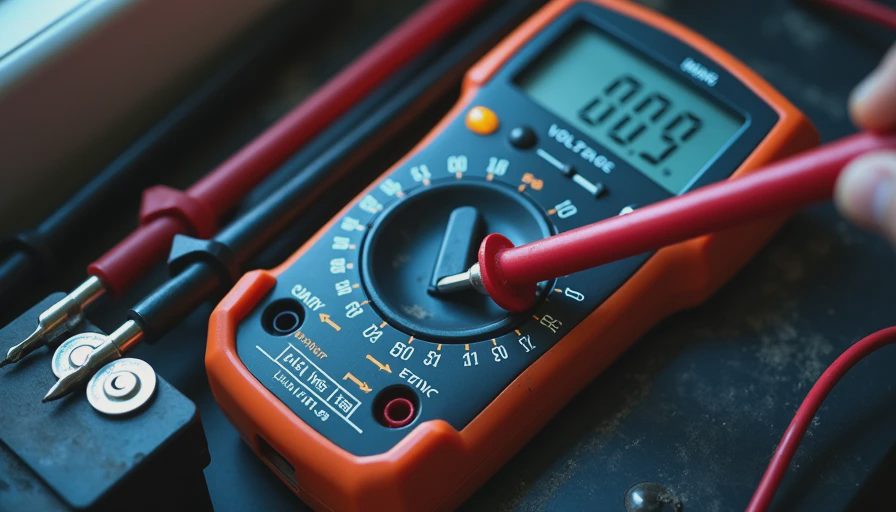
Step 1: Take the resting voltage reading
To test car battery with multimeter, connect the red probe to the positive terminal and the black probe to the negative terminal. Touch clean metal on the terminal posts, not just corrosion or a loose clamp. The meter should display a positive number. If it shows a minus sign, reverse the probes; no damage occurs when measuring voltage correctly.
A fully charged, healthy 12-volt battery normally reads about 12.6 to 12.8 volts at rest. Around 12.4 volts indicates roughly 75 percent charge, while 12.2 volts is near half charge. A reading near 12.0 volts indicates a heavily discharged battery, not necessarily a permanently bad one. Recharge it with a suitable automotive battery charger, let it rest again, and repeat the measurement.
If the reading remains below 12.4 volts after a complete charge, suspect sulfation, an internal short, or a battery that has reached the end of its service life. Many automotive batteries last three to five years, but heat, vibration, repeated deep discharges, and long periods parked can shorten that range. Record the voltage and date in your maintenance notes rather than relying on memory.
Step 2: Test voltage while cranking
A resting reading cannot show how well the battery performs under load. Have another person sit in the driver seat, or use a remote starter procedure only if the vehicle manufacturer allows it. Keep the probes connected to the battery posts and watch the display while the engine cranks for several seconds.
A healthy battery commonly stays above approximately 9.6 volts during cranking at room temperature. The exact result depends on temperature, engine size, starter condition, and battery design. A drop into the 8-volt range, especially with slow cranking, strongly suggests insufficient battery capacity or high resistance inside the battery. Before condemning it, confirm that the terminals are clean and tight and that the engine is not unusually difficult to turn.
Do not hold the starter continuously while testing. Crank for five seconds, then allow the starter to cool. If the voltage looks acceptable but the starter turns slowly, inspect the positive cable, engine ground strap, and starter current draw. A voltage-drop test can find resistance that a simple battery reading misses.
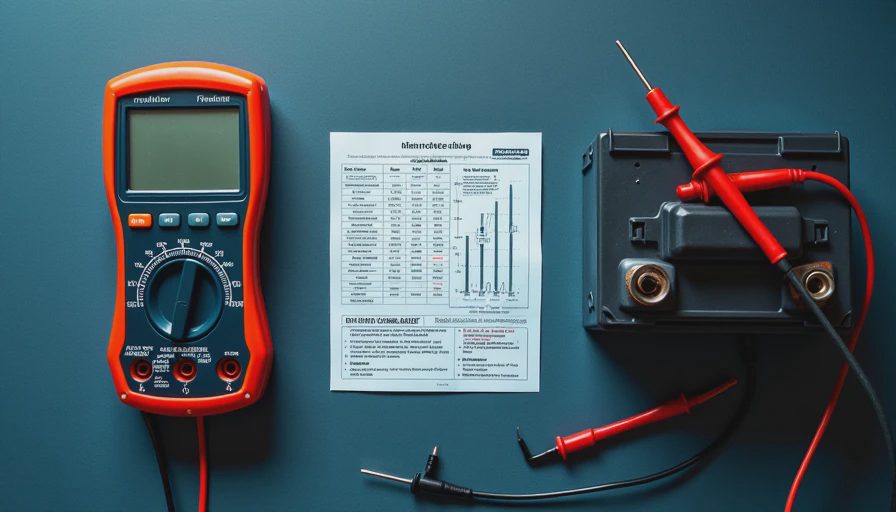
Step 3: Check the alternator charging voltage
Once the engine starts, test car battery with multimeter again while the engine idles. Keep hands, sleeves, and meter leads away from the belt, pulleys, cooling fan, and exhaust. The charging voltage at the battery commonly falls between 13.7 and 14.7 volts, although smart charging systems can deliberately vary the output. Turn on the headlights, blower motor, and rear defroster, then watch the reading. It should remain reasonably stable rather than collapsing toward battery voltage.
A result around 12.2 to 12.8 volts with the engine running indicates that the alternator may not be charging. Inspect the serpentine belt, battery connections, main fuse, and alternator wiring before replacing parts. A reading above about 15 volts can indicate a regulator problem that risks damaging electronic components and the battery. Modern vehicles with battery sensors or start-stop systems require vehicle-specific test procedures, so do not assume a fixed voltage is always a fault.
If the alternator output is normal but the battery repeatedly goes flat overnight, look for a parasitic drain. That diagnosis requires a different meter setup and should not be attempted by placing the meter across the battery in amperage mode.
Common mistakes and a practical diagnosis
The most frequent error is testing immediately after driving. Another is probing dirty clamps instead of the lead posts, which can produce inconsistent results. A third is replacing the battery when the real problem is a loose ground cable or undercharging alternator. Clean light corrosion with a battery-terminal brush, tighten the connections, and repeat the tests under comparable conditions.
For example, a battery that reads 12.65 volts after charging, falls to 10.2 volts during cranking, and receives 14.2 volts from the alternator is probably serviceable. A battery that reads 12.6 volts but drops to 8.7 volts during cranking is not passing a meaningful load test, even though its resting number looks excellent. A battery reading 12.1 volts at rest and 12.3 volts with the engine running points toward both low charge and a charging-system problem.
When to replace or confirm the result
Use a dedicated conductance tester or a parts-store load test when the multimeter results are borderline. Those tests assess starting capacity more directly and often produce a pass, recharge, or replace result. Replacement batteries commonly cost $120 to $300, depending on group size, cold-cranking rating, warranty, and whether the vehicle uses AGM technology. Match the original battery type and required rating; do not substitute a standard flooded battery for an AGM application without confirming compatibility.
If you test car battery with multimeter and find a bad result, photograph the readings and inspect the date code before buying parts. Install the replacement with the correct polarity, secure the hold-down, and recycle the old battery. Afterward, repeat the resting and running-voltage checks. A documented baseline makes the next starting problem easier to diagnose and helps separate battery failure from alternator or cable trouble.



No comments yet — grab the first one.